Rapid7 InsightVM
Elastic Cloud Serverless projects are autoscaled environments, fully managed by Elastic and available on Elastic Cloud. Availability This functionality is generally available and ready for production usage. Elastic Cloud Serverless projects are autoscaled environments, fully managed by Elastic and available on Elastic Cloud. Availability This functionality is generally available and ready for production usage. The Elastic Stack includes Elastic's core products such as Elasticsearch, Kibana, Logstash, and Beats. Availability This functionality is generally available and ready for production usage. Unless stated otherwise on the page, this functionality is available when your Elastic Stack is deployed on Elastic Cloud Hosted, Elastic Cloud Enterprise, Elastic Cloud on Kubernetes, and self-managed environments. This documentation corresponds to the latest patch available for each minor version. If you're not using the latest patch, check the release notes for changes.
Serverless Observability
Generally available
Serverless Security
Generally available
Stack
9.1+
Generally available since 9.1
| Version | 2.14.0 (View all) |
| Managed integration release status | GA |
| Subscription level What's this? |
Basic |
| Developed by What's this? |
Elastic |
| Ingestion method(s) | API |
| Minimum Kibana version(s) | 9.1.4 8.19.4 |
You can use this integration as an Elastic Managed integration on Elastic Cloud Hosted deployments running this version or later.
The Rapid7 InsightVM integration allows users to monitor Asset and Vulnerability Events. Rapid7 InsightVM discovers risks across all your endpoints, cloud, and virtualized infrastructure. Prioritize risks and provide step-by-step directions to IT and DevOps for more efficient remediation. View your risk in real-time right from your dashboard. Measure and communicate progress on your program goals.
Use the Rapid7 InsightVM integration to collect and parse data from the REST APIs. Then visualize that data in Kibana.
The Rapid7 InsightVM integration collects two type of events: Asset and Vulnerability.
Asset Vulnerability is used to gather and aggregate data on assets and vulnerabilities to support Native CDR Workflows.
Vulnerability is used to retrieve all vulnerabilities that can be assessed. See more details in the API documentation here.
Asset - DEPRECATED since version 2.0.0; it will be removed in a future release. It is used to get details related to inventory, assessment, and summary details of assets that the user has access to. See more details in the API documentation here. Deactivate it and instead enable Asset Vulnerability in the Collect Rapid7 InsightVM asset vulnerability events via API input for enriched vulnerability documents and improved mappings.
Elastic Agent must be installed. For more details, check the Elastic Agent installation instructions.
Elastic Managed integrations are only supported on Elastic Cloud Serverless and Elastic Cloud Hosted deployments. An Elastic Managed integration lets you ingest data from a cloud source while avoiding the orchestration, management, and maintenance associated with standard ingest infrastructure. Elastic runs the collector for you, so you can focus on your data instead of the infrastructure that collects it.
For more information, refer to Elastic Managed integrations and the Elastic Managed integrations FAQ.
This module uses InsightVM Cloud Integrations API v4.
- Generate the platform API key to access all Rapid7 InsightVM APIs. For more details, see Documentation.
Version 2.0.0 of the Rapid7 InsightVM integration adds support for Elastic Cloud Security workflow. The enhancement enables the users of Rapid7 InsightVM integration to ingest their enriched asset vulnerabilities from Rapid7 InsightVM platform into Elastic and get insights directly from Elastic Vulnerability Findings page.
This update adds Elastic Latest Transform which copies the latest vulnerability findings from source indices matching the pattern logs-rapid7_insightvm.asset_vulnerability-* into new destination indices matching the pattern security_solution-rapid7_insightvm.vulnerability_latest-*. The Elastic Vulnerability Findings page will display vulnerabilities based on the destination indices.
For existing users of Rapid7 InsightVM integration, before upgrading to 2.0.0 please ensure following requirements are met:
- Users need Elastic Security solution which has requirements documented here.
- To use transforms, users must have:
- at least one transform node,
- management features visible in the Kibana space, and
- security privileges that:
- grant use of transforms, and
- grant access to source and destination indices For more details on Transform Setup, refer to the link here
- Because the latest copy of vulnerabilities is now indexed in two places, i.e., in both source and destination indices, users must anticipate storage requirements accordingly.
This is the asset_vulnerability dataset.
Example
{
    "@timestamp": "2025-05-27T18:21:36.279Z",
    "agent": {
        "ephemeral_id": "6791a699-9aa4-48a9-b74b-52f7d5f69aee",
        "id": "2ee34ce2-2eab-4e18-b86e-0c9e82820d6f",
        "name": "elastic-agent-49978",
        "type": "filebeat",
        "version": "8.19.4"
    },
    "data_stream": {
        "dataset": "rapid7_insightvm.asset_vulnerability",
        "namespace": "58811",
        "type": "logs"
    },
    "ecs": {
        "version": "8.11.0"
    },
    "elastic_agent": {
        "id": "2ee34ce2-2eab-4e18-b86e-0c9e82820d6f",
        "snapshot": false,
        "version": "8.19.4"
    },
    "event": {
        "agent_id_status": "verified",
        "category": [
            "vulnerability"
        ],
        "created": "2025-05-12T16:25:35.000Z",
        "dataset": "rapid7_insightvm.asset_vulnerability",
        "id": "8babcde1-1234-5678-0912-cabcdef1284e-default-asset-6|unix-anonymous-root-logins|2025-05-27T18:21:36.279Z",
        "ingested": "2026-03-16T12:09:00Z",
        "kind": "event",
        "original": "{\"assessed_for_policies\":false,\"assessed_for_vulnerabilities\":true,\"credential_assessments\":[{\"port\":22,\"protocol\":\"TCP\",\"status\":\"NO_CREDS_SUPPLIED\"}],\"critical_vulnerabilities\":3,\"exploits\":0,\"host_name\":\"computer-test\",\"id\":\"8babcde1-1234-5678-0912-cabcdef1284e-default-asset-6\",\"ip\":\"10.50.5.112\",\"last_assessed_for_vulnerabilities\":\"2025-05-27T18:21:36.279Z\",\"last_scan_end\":\"2025-05-27T18:21:36.279Z\",\"last_scan_start\":\"2025-05-27T18:20:41.505Z\",\"mac\":\"00:00:5E:00:53:02\",\"malware_kits\":0,\"moderate_vulnerabilities\":1,\"os_architecture\":\"x86_64\",\"os_description\":\"Red Hat Enterprise Linux 7.9\",\"os_family\":\"Linux\",\"os_name\":\"Enterprise Linux\",\"os_system_name\":\"Red Hat Linux\",\"os_type\":\"\",\"os_vendor\":\"Red Hat\",\"os_version\":\"7.9\",\"risk_score\":18250,\"severe_vulnerabilities\":48,\"tags\":[{\"name\":\"Ahmedabad\",\"type\":\"LOCATION\"},{\"name\":\"test\",\"type\":\"SITE\"},{\"name\":\"rapid7 insight agents\",\"type\":\"SITE\"}],\"total_vulnerabilities\":52,\"type\":\"guest\",\"unique_identifiers\":[{\"id\":\"CEF12345-ABCD-1234-ABCD-95ABCDEF1234\",\"source\":\"dmidecode\"},{\"id\":\"e80644e940123456789abcdef66a8b16\",\"source\":\"R7 Agent\"}],\"vulnerability\":{\"added\":\"2004-11-30T00:00:00Z\",\"categories\":\"CVSS Score Predicted with Rapid7 AI,UNIX\",\"check_id\":null,\"cves\":\"\",\"cvss_v2_access_complexity\":\"low\",\"cvss_v2_access_vector\":\"network\",\"cvss_v2_authentication\":\"single\",\"cvss_v2_availability_impact\":\"partial\",\"cvss_v2_confidentiality_impact\":\"partial\",\"cvss_v2_exploit_score\":7.9520000338554375,\"cvss_v2_impact_score\":6.442976653521584,\"cvss_v2_integrity_impact\":\"partial\",\"cvss_v2_score\":6.5,\"cvss_v2_vector\":\"(AV:N/AC:L/Au:S/C:P/I:P/A:P)\",\"cvss_v3_attack_complexity\":\"low\",\"cvss_v3_attack_vector\":\"local\",\"cvss_v3_availability_impact\":\"high\",\"cvss_v3_confidentiality_impact\":\"high\",\"cvss_v3_exploit_score\":2.515145325,\"cvss_v3_impact_score\":5.873118720000001,\"cvss_v3_integrity_impact\":\"high\",\"cvss_v3_privileges_required\":\"none\",\"cvss_v3_scope\":\"unchanged\",\"cvss_v3_score\":8.4,\"cvss_v3_user_interaction\":\"none\",\"cvss_v3_vector\":\"CVSS:3.0/AV:L/AC:L/PR:N/UI:N/S:U/C:H/I:H/A:H\",\"denial_of_service\":false,\"description\":\"Anonymous root logins should only be allowed from system console. /etc/securetty allows you to specify on which tty's and virtual consoles root is allowed to login. The tty and vc's listed in this file will allow root to login on certain tty's and VC's. On other tty or vc's root user will not be allowed and user has to \\\"su\\\" to become root.\",\"exploits\":[],\"first_found\":\"2025-05-12T16:25:35Z\",\"id\":\"unix-anonymous-root-logins\",\"key\":\"\",\"last_found\":\"2025-05-27T18:21:36.279Z\",\"links\":[],\"malware_kits\":[],\"modified\":\"2025-02-18T00:00:00Z\",\"nic\":null,\"pci_cvss_score\":6.5,\"pci_fail\":true,\"pci_severity_score\":4,\"pci_special_notes\":\"\",\"pci_status\":\"fail\",\"port\":null,\"proof\":\"\\u003cp\\u003e\\u003cp\\u003eFollowing entries in /etc/securetty \\n                                 may allow anonymous root logins: \\u003cul\\u003e\\u003cli\\u003ettyS0\\u003c/li\\u003e\\u003cli\\u003ettysclp0\\u003c/li\\u003e\\u003cli\\u003esclp_line0\\u003c/li\\u003e\\u003cli\\u003e3270/tty1\\u003c/li\\u003e\\u003cli\\u003ehvc0\\u003c/li\\u003e\\u003cli\\u003ehvc1\\u003c/li\\u003e\\u003cli\\u003ehvc2\\u003c/li\\u003e\\u003cli\\u003ehvc3\\u003c/li\\u003e\\u003cli\\u003ehvc4\\u003c/li\\u003e\\u003cli\\u003ehvc5\\u003c/li\\u003e\\u003cli\\u003ehvc6\\u003c/li\\u003e\\u003cli\\u003ehvc7\\u003c/li\\u003e\\u003cli\\u003ehvsi0\\u003c/li\\u003e\\u003cli\\u003ehvsi1\\u003c/li\\u003e\\u003cli\\u003ehvsi2\\u003c/li\\u003e\\u003cli\\u003exvc0\\u003c/li\\u003e\\u003c/ul\\u003e\\u003c/p\\u003e\\u003c/p\\u003e\",\"protocol\":null,\"published\":\"2004-11-30T00:00:00Z\",\"references\":\"\",\"reintroduced\":null,\"risk_score\":562,\"severity\":\"severe\",\"severity_score\":7,\"solution_fix\":\"\\u003cp\\u003e\\u003cp\\u003eRemove all the entries in /etc/securetty except console,\\n            tty[0-9]* and vc\\\\[0-9]* \\u003c/p\\u003e\\u003cp\\u003eNote: ssh does not use /etc/securetty. To disable root login\\n            through ssh, use the \\u0026quot;PermitRootLogin\\u0026quot; setting in /etc/ssh/sshd_config\\n            and restart the ssh daemon. \\u003c/p\\u003e\\u003c/p\\u003e\",\"solution_id\":\"unix-anonymous-root-logins\",\"solution_summary\":\"Edit '/etc/securetty' entries\",\"solution_type\":\"workaround\",\"status\":\"VULNERABLE_EXPL\",\"title\":\"Anonymous root login is allowed\",\"vulnerability_id\":\"unix-anonymous-root-logins\"}}",
        "severity": 7,
        "type": [
            "info"
        ]
    },
    "host": {
        "architecture": "x86_64",
        "hostname": "computer-test",
        "id": "8babcde1-1234-5678-0912-cabcdef1284e-default-asset-6",
        "ip": [
            "10.50.5.112"
        ],
        "mac": [
            "00-00-5E-00-53-02"
        ],
        "name": "computer-test",
        "os": {
            "family": "Linux",
            "full": "Red Hat Enterprise Linux 7.9",
            "name": "Enterprise Linux",
            "platform": "linux",
            "type": "linux",
            "version": "7.9"
        },
        "risk": {
            "static_score": 18250
        },
        "type": "guest"
    },
    "input": {
        "type": "cel"
    },
    "observer": {
        "product": "Rapid7 InsightVM",
        "vendor": "Rapid7"
    },
    "rapid7_insightvm": {
        "asset_vulnerability": {
            "assessed_for_policies": false,
            "assessed_for_vulnerabilities": true,
            "critical_vulnerabilities": 3,
            "exploits": 0,
            "host_name": "computer-test",
            "id": "8babcde1-1234-5678-0912-cabcdef1284e-default-asset-6",
            "ip": "10.50.5.112",
            "last_assessed_for_vulnerabilities": "2025-05-27T18:21:36.279Z",
            "last_scan_end": "2025-05-27T18:21:36.279Z",
            "last_scan_start": "2025-05-27T18:20:41.505Z",
            "mac": "00-00-5E-00-53-02",
            "malware_kits": 0,
            "moderate_vulnerabilities": 1,
            "os": {
                "architecture": "x86_64",
                "description": "Red Hat Enterprise Linux 7.9",
                "family": "Linux",
                "name": "Enterprise Linux",
                "system_name": "Red Hat Linux",
                "vendor": "Red Hat",
                "version": "7.9"
            },
            "risk_score": 18250,
            "severe_vulnerabilities": 48,
            "total_vulnerabilities": 52,
            "type": "guest",
            "unique_identifiers": [
                {
                    "id": "CEF12345-ABCD-1234-ABCD-95ABCDEF1234",
                    "source": "dmidecode"
                },
                {
                    "id": "e80644e940123456789abcdef66a8b16",
                    "source": "R7 Agent"
                }
            ],
            "unique_identifiers_nested": [
                {
                    "id": "CEF12345-ABCD-1234-ABCD-95ABCDEF1234",
                    "source": "dmidecode"
                },
                {
                    "id": "e80644e940123456789abcdef66a8b16",
                    "source": "R7 Agent"
                }
            ],
            "vulnerability": {
                "added": "2004-11-30T00:00:00.000Z",
                "categories": [
                    "CVSS Score Predicted with Rapid7 AI",
                    "UNIX"
                ],
                "cvss_v2": {
                    "access_complexity": "low",
                    "access_vector": "network",
                    "authentication": "single",
                    "availability_impact": "partial",
                    "confidentiality_impact": "partial",
                    "exploit_score": 7.9520000338554375,
                    "impact_score": 6.442976653521584,
                    "integrity_impact": "partial",
                    "score": 6.5,
                    "vector": "(AV:N/AC:L/Au:S/C:P/I:P/A:P)"
                },
                "cvss_v3": {
                    "attack_complexity": "low",
                    "attack_vector": "local",
                    "availability_impact": "high",
                    "confidentiality_impact": "high",
                    "exploit_score": 2.515145325,
                    "impact_score": 5.873118720000001,
                    "integrity_impact": "high",
                    "privileges_required": "none",
                    "scope": "unchanged",
                    "score": 8.4,
                    "user_interaction": "none",
                    "vector": "CVSS:3.0/AV:L/AC:L/PR:N/UI:N/S:U/C:H/I:H/A:H"
                },
                "denial_of_service": false,
                "description": "Anonymous root logins should only be allowed from system console. /etc/securetty allows you to specify on which tty's and virtual consoles root is allowed to login. The tty and vc's listed in this file will allow root to login on certain tty's and VC's. On other tty or vc's root user will not be allowed and user has to \"su\" to become root.",
                "first_found": "2025-05-12T16:25:35.000Z",
                "id": "unix-anonymous-root-logins",
                "last_found": "2025-05-27T18:21:36.279Z",
                "modified": "2025-02-18T00:00:00.000Z",
                "pci": {
                    "cvss_score": 6.5,
                    "fail": true,
                    "severity_score": 4,
                    "status": "fail"
                },
                "proof": "Following entries in /etc/securetty \n                                 may allow anonymous root logins: \n\nttyS0\n\nttysclp0\n\nsclp_line0\n\n3270/tty1\n\nhvc0\n\nhvc1\n\nhvc2\n\nhvc3\n\nhvc4\n\nhvc5\n\nhvc6\n\nhvc7\n\nhvsi0\n\nhvsi1\n\nhvsi2\n\nxvc0",
                "published": "2004-11-30T00:00:00.000Z",
                "risk_score": 562,
                "severity": "severe",
                "severity_score": 7,
                "solution": {
                    "fix": "Remove all the entries in /etc/securetty except console,\n            tty[0-9]* and vc\\[0-9]* \n\nNote: ssh does not use /etc/securetty. To disable root login\n            through ssh, use the \"PermitRootLogin\" setting in /etc/ssh/sshd_config\n            and restart the ssh daemon.",
                    "id": "unix-anonymous-root-logins",
                    "summary": "Edit '/etc/securetty' entries",
                    "type": "workaround"
                },
                "status": "VULNERABLE_EXPL",
                "title": "Anonymous root login is allowed"
            }
        }
    },
    "related": {
        "hosts": [
            "computer-test",
            "8babcde1-1234-5678-0912-cabcdef1284e-default-asset-6"
        ],
        "ip": [
            "10.50.5.112"
        ]
    },
    "resource": {
        "id": "8babcde1-1234-5678-0912-cabcdef1284e-default-asset-6",
        "name": "computer-test"
    },
    "tags": [
        "preserve_original_event",
        "preserve_duplicate_custom_fields",
        "forwarded",
        "rapid7_insightvm-asset_vulnerability"
    ],
    "vulnerability": {
        "category": [
            "CVSS Score Predicted with Rapid7 AI",
            "UNIX"
        ],
        "classification": "CVSS",
        "description": "Anonymous root logins should only be allowed from system console. /etc/securetty allows you to specify on which tty's and virtual consoles root is allowed to login. The tty and vc's listed in this file will allow root to login on certain tty's and VC's. On other tty or vc's root user will not be allowed and user has to \"su\" to become root.",
        "enumeration": "CVE",
        "published_date": "2004-11-30T00:00:00.000Z",
        "scanner": {
            "name": "e80644e940123456789abcdef66a8b16",
            "vendor": "Rapid7"
        },
        "score": {
            "base": 8.4,
            "version": "3.0"
        },
        "severity": "High",
        "title": "Anonymous root login is allowed"
    }
}
Exported fields
| Field | Description | Type |
|---|---|---|
| @timestamp | Date/time when the event originated. This is the date/time extracted from the event, typically representing when the event was generated by the source. If the event source has no original timestamp, this value is typically populated by the first time the event was received by the pipeline. Required field for all events. | date |
| data_stream.dataset | The field can contain anything that makes sense to signify the source of the data. Examples include nginx.access, prometheus, endpoint etc. For data streams that otherwise fit, but that do not have dataset set we use the value "generic" for the dataset value. event.dataset should have the same value as data_stream.dataset. Beyond the Elasticsearch data stream naming criteria noted above, the dataset value has additional restrictions: * Must not contain - * No longer than 100 characters |
constant_keyword |
| data_stream.namespace | A user defined namespace. Namespaces are useful to allow grouping of data. Many users already organize their indices this way, and the data stream naming scheme now provides this best practice as a default. Many users will populate this field with default. If no value is used, it falls back to default. Beyond the Elasticsearch index naming criteria noted above, namespace value has the additional restrictions: * Must not contain - * No longer than 100 characters |
constant_keyword |
| data_stream.type | An overarching type for the data stream. Currently allowed values are "logs" and "metrics". We expect to also add "traces" and "synthetics" in the near future. | constant_keyword |
| event.dataset | Name of the dataset. If an event source publishes more than one type of log or events (e.g. access log, error log), the dataset is used to specify which one the event comes from. It's recommended but not required to start the dataset name with the module name, followed by a dot, then the dataset name. | constant_keyword |
| event.module | Name of the module this data is coming from. If your monitoring agent supports the concept of modules or plugins to process events of a given source (e.g. Apache logs), event.module should contain the name of this module. |
constant_keyword |
| input.type | Type of filebeat input. | keyword |
| log.offset | Log offset. | long |
| observer.vendor | Vendor name of the observer. | constant_keyword |
| package.fixed_version | keyword | |
| package.name | Package name | keyword |
| package.version | Package version | keyword |
| rapid7_insightvm.asset_vulnerability.assessed_for_policies | Whether an asset was assessed for policies. | boolean |
| rapid7_insightvm.asset_vulnerability.assessed_for_vulnerabilities | Whether an asset was assessed for vulnerabilities. | boolean |
| rapid7_insightvm.asset_vulnerability.credential_assessments.port | The port the authentication was used on. | long |
| rapid7_insightvm.asset_vulnerability.credential_assessments.protocol | The protocol the authentication was used on. | keyword |
| rapid7_insightvm.asset_vulnerability.credential_assessments.status | The authentication of the last scan performed. | keyword |
| rapid7_insightvm.asset_vulnerability.credential_assessments_nested.port | The port the authentication was used on. | long |
| rapid7_insightvm.asset_vulnerability.credential_assessments_nested.protocol | The protocol the authentication was used on. | keyword |
| rapid7_insightvm.asset_vulnerability.credential_assessments_nested.status | The authentication of the last scan performed. | keyword |
| rapid7_insightvm.asset_vulnerability.critical_vulnerabilities | The count of critical vulnerability findings. | long |
| rapid7_insightvm.asset_vulnerability.exploits | The count of known unique exploits that can be used to exploit vulnerabilities on the asset. | long |
| rapid7_insightvm.asset_vulnerability.host_name | The host name (local or FQDN). | keyword |
| rapid7_insightvm.asset_vulnerability.id | The identifier of the asset. | keyword |
| rapid7_insightvm.asset_vulnerability.ip | The IPv4 or IPv6 address. | ip |
| rapid7_insightvm.asset_vulnerability.last_assessed_for_vulnerabilities | The time at which an asset was assessed for vulnerabilities. | date |
| rapid7_insightvm.asset_vulnerability.last_scan_end | The time at which the last scan of the asset ended. | date |
| rapid7_insightvm.asset_vulnerability.last_scan_start | The time at which the last scan of the asset started. | date |
| rapid7_insightvm.asset_vulnerability.mac | The Media Access Control (MAC) address. The format is six groups of two hexadecimal digits separated by colons. | keyword |
| rapid7_insightvm.asset_vulnerability.malware_kits | The count of known unique malware kits that can be used to attack vulnerabilities on the asset. | long |
| rapid7_insightvm.asset_vulnerability.moderate_vulnerabilities | The count of moderate vulnerability findings. | long |
| rapid7_insightvm.asset_vulnerability.os.architecture | The architecture of the operating system. | keyword |
| rapid7_insightvm.asset_vulnerability.os.description | The description of the operating system (containing vendor, family, product, version and architecture in a single string). | keyword |
| rapid7_insightvm.asset_vulnerability.os.family | The family of the operating system. | keyword |
| rapid7_insightvm.asset_vulnerability.os.name | The name of the operating system. | keyword |
| rapid7_insightvm.asset_vulnerability.os.system_name | A combination of vendor and family (with redundancies removed), suitable for grouping. | keyword |
| rapid7_insightvm.asset_vulnerability.os.type | The type of operating system. | keyword |
| rapid7_insightvm.asset_vulnerability.os.vendor | The vendor of the operating system. | keyword |
| rapid7_insightvm.asset_vulnerability.os.version | The version of the operating system. | keyword |
| rapid7_insightvm.asset_vulnerability.risk_score | The risk score (with criticality adjustments) of the asset. | double |
| rapid7_insightvm.asset_vulnerability.severe_vulnerabilities | The count of severe vulnerability findings. | long |
| rapid7_insightvm.asset_vulnerability.tags.name | The stored value. | keyword |
| rapid7_insightvm.asset_vulnerability.tags.type | The type of information stored and displayed. For sites, the value is "SITE". | keyword |
| rapid7_insightvm.asset_vulnerability.tags_nested.name | The stored value. | keyword |
| rapid7_insightvm.asset_vulnerability.tags_nested.type | The type of information stored and displayed. For sites, the value is "SITE". | keyword |
| rapid7_insightvm.asset_vulnerability.total_vulnerabilities | The total count of vulnerability findings. | long |
| rapid7_insightvm.asset_vulnerability.type | The type of asset. | keyword |
| rapid7_insightvm.asset_vulnerability.unique_identifiers.id | The unique identifier. | keyword |
| rapid7_insightvm.asset_vulnerability.unique_identifiers.source | The source of the unique identifier. | keyword |
| rapid7_insightvm.asset_vulnerability.unique_identifiers_nested.id | The unique identifier. | keyword |
| rapid7_insightvm.asset_vulnerability.unique_identifiers_nested.source | The source of the unique identifier. | keyword |
| rapid7_insightvm.asset_vulnerability.vulnerability.added | The date the vulnerability coverage was added. The format is an ISO 8601 date, YYYY-MM-DD. | date |
| rapid7_insightvm.asset_vulnerability.vulnerability.categories | Comma-separated list of categories the vulnerability is classified under. | keyword |
| rapid7_insightvm.asset_vulnerability.vulnerability.check_id | The identifier of the vulnerability check. | keyword |
| rapid7_insightvm.asset_vulnerability.vulnerability.cves | All CVEs assigned to this vulnerability. | keyword |
| rapid7_insightvm.asset_vulnerability.vulnerability.cvss_v2.access_complexity | Access Complexity (AC) component which measures the complexity of the attack required to exploit the vulnerability once an attacker has gained access to the target system. | keyword |
| rapid7_insightvm.asset_vulnerability.vulnerability.cvss_v2.access_vector | Access Vector (Av) component which reflects how the vulnerability is exploited. | keyword |
| rapid7_insightvm.asset_vulnerability.vulnerability.cvss_v2.authentication | Authentication (Au) component which measures the number of times an attacker must authenticate to a target in order to exploit a vulnerability. | keyword |
| rapid7_insightvm.asset_vulnerability.vulnerability.cvss_v2.availability_impact | Availability Impact (A) component which measures the impact to availability of a successfully exploited vulnerability. | keyword |
| rapid7_insightvm.asset_vulnerability.vulnerability.cvss_v2.confidentiality_impact | Confidentiality Impact (C) component which measures the impact on confidentiality of a successfully exploited vulnerability. | keyword |
| rapid7_insightvm.asset_vulnerability.vulnerability.cvss_v2.exploit_score | The CVSS exploit score. | double |
| rapid7_insightvm.asset_vulnerability.vulnerability.cvss_v2.impact_score | The CVSS impact score. | double |
| rapid7_insightvm.asset_vulnerability.vulnerability.cvss_v2.integrity_impact | Integrity Impact (I) component measures the impact to integrity of a successfully exploited vulnerability. | keyword |
| rapid7_insightvm.asset_vulnerability.vulnerability.cvss_v2.score | The CVSS score, which ranges from 0-10. | double |
| rapid7_insightvm.asset_vulnerability.vulnerability.cvss_v2.vector | The CVSS v2 vector. | keyword |
| rapid7_insightvm.asset_vulnerability.vulnerability.cvss_v3.attack_complexity | Attack Complexity (AC) component with measures the conditions beyond the attacker's control that must exist in order to exploit the vulnerability. | keyword |
| rapid7_insightvm.asset_vulnerability.vulnerability.cvss_v3.attack_vector | Attack Vector (AV) component which measures context by which vulnerability exploitation is possible. | keyword |
| rapid7_insightvm.asset_vulnerability.vulnerability.cvss_v3.availability_impact | Availability Impact (A) measures the impact to the availability of the impacted component resulting from a successfully exploited vulnerability. | keyword |
| rapid7_insightvm.asset_vulnerability.vulnerability.cvss_v3.confidentiality_impact | Confidentiality Impact (C) component which measures the impact on confidentiality of a successfully exploited vulnerability. | keyword |
| rapid7_insightvm.asset_vulnerability.vulnerability.cvss_v3.exploit_score | The CVSS exploit score. | double |
| rapid7_insightvm.asset_vulnerability.vulnerability.cvss_v3.impact_score | The CVSS impact score. | double |
| rapid7_insightvm.asset_vulnerability.vulnerability.cvss_v3.integrity_impact | Integrity Impact (I) measures the impact to integrity of a successfully exploited vulnerability. Integrity refers to the trustworthiness and veracity of information. | keyword |
| rapid7_insightvm.asset_vulnerability.vulnerability.cvss_v3.privileges_required | Privileges Required (PR) measures the level of privileges an attacker must possess before successfully exploiting the vulnerability. | keyword |
| rapid7_insightvm.asset_vulnerability.vulnerability.cvss_v3.scope | Scope (S) measures the collection of privileges defined by a computing authority (e.g. an application, an operating system, or a sandbox environment) when granting access to computing resources (e.g. files, CPU, memory, etc). These privileges are assigned based on some method of identification and authorization. | keyword |
| rapid7_insightvm.asset_vulnerability.vulnerability.cvss_v3.score | The CVSS score, which ranges from 0-10. | double |
| rapid7_insightvm.asset_vulnerability.vulnerability.cvss_v3.user_interaction | User Interaction (UI) measures the requirement for a user, other than the attacker, to participate in the successful compromise of the vulnerable component. | keyword |
| rapid7_insightvm.asset_vulnerability.vulnerability.cvss_v3.vector | The CVSS v3 vector. | keyword |
| rapid7_insightvm.asset_vulnerability.vulnerability.denial_of_service | Whether the vulnerability can lead to Denial of Service (DoS). | boolean |
| rapid7_insightvm.asset_vulnerability.vulnerability.description | A verbose description of the vulnerability. | keyword |
| rapid7_insightvm.asset_vulnerability.vulnerability.exploits.description | A verbose description of the exploit. | keyword |
| rapid7_insightvm.asset_vulnerability.vulnerability.exploits.id | The identifier of the exploit. | keyword |
| rapid7_insightvm.asset_vulnerability.vulnerability.exploits.name | The name of the exploit. | keyword |
| rapid7_insightvm.asset_vulnerability.vulnerability.exploits.rank | How common the exploit is used. | keyword |
| rapid7_insightvm.asset_vulnerability.vulnerability.exploits.skill_level | The level of skill required to use the exploit. | keyword |
| rapid7_insightvm.asset_vulnerability.vulnerability.exploits.source | Details about where the exploit is defined. | keyword |
| rapid7_insightvm.asset_vulnerability.vulnerability.first_found | The first time the vulnerability was discovered. | date |
| rapid7_insightvm.asset_vulnerability.vulnerability.id | The identifier of the vulnerability. | keyword |
| rapid7_insightvm.asset_vulnerability.vulnerability.is_enriched | Whether the enriched vulnerability information is available. | boolean |
| rapid7_insightvm.asset_vulnerability.vulnerability.is_remediated | Whether the vulnerability has been remediated. | boolean |
| rapid7_insightvm.asset_vulnerability.vulnerability.key | The identifier of the assessment key. | keyword |
| rapid7_insightvm.asset_vulnerability.vulnerability.last_found | The most recent time the vulnerability was discovered. | date |
| rapid7_insightvm.asset_vulnerability.vulnerability.links.href | keyword | |
| rapid7_insightvm.asset_vulnerability.vulnerability.links.id | keyword | |
| rapid7_insightvm.asset_vulnerability.vulnerability.links.rel | keyword | |
| rapid7_insightvm.asset_vulnerability.vulnerability.links.source | keyword | |
| rapid7_insightvm.asset_vulnerability.vulnerability.malware_kits.description | A known Malware Kit that can be used to compromise a vulnerability. | keyword |
| rapid7_insightvm.asset_vulnerability.vulnerability.malware_kits.name | The name of the malware kit. | keyword |
| rapid7_insightvm.asset_vulnerability.vulnerability.malware_kits.popularity | The popularity of the malware kit. | keyword |
| rapid7_insightvm.asset_vulnerability.vulnerability.modified | The last date the vulnerability was modified. The format is an ISO 8601 date, YYYY-MM-DD. | date |
| rapid7_insightvm.asset_vulnerability.vulnerability.pci.cvss_score | The CVSS score of the vulnerability, adjusted for PCI rules and exceptions, on a scale of 0-10. | double |
| rapid7_insightvm.asset_vulnerability.vulnerability.pci.fail | Whether if present on a host this vulnerability would cause a PCI failure. true if compliance status is "fail", false otherwise. | boolean |
| rapid7_insightvm.asset_vulnerability.vulnerability.pci.severity_score | The severity score of the vulnerability, adjusted for PCI rules and exceptions, on a scale of 0-10. | long |
| rapid7_insightvm.asset_vulnerability.vulnerability.pci.special_notes | Any special notes or remarks about the vulnerability that pertain to PCI compliance. | keyword |
| rapid7_insightvm.asset_vulnerability.vulnerability.pci.status | The PCI compliance status. | keyword |
| rapid7_insightvm.asset_vulnerability.vulnerability.port | For services vulnerabilities, the port that is vulnerable. | long |
| rapid7_insightvm.asset_vulnerability.vulnerability.proof | The identifier of the vulnerability proof. | keyword |
| rapid7_insightvm.asset_vulnerability.vulnerability.protocol | For services vulnerabilities, the protocol that is vulnerable. | keyword |
| rapid7_insightvm.asset_vulnerability.vulnerability.published | The date the vulnerability was first published or announced. The format is an ISO 8601 date, YYYY-MM-DD. | date |
| rapid7_insightvm.asset_vulnerability.vulnerability.references | References to security standards this vulnerability is a part of, in condensed format (comma-separated). | keyword |
| rapid7_insightvm.asset_vulnerability.vulnerability.risk_score | The risk score of the vulnerability. If using the default Rapid7 Real Risk™ model, this value ranges from 0-1000. | double |
| rapid7_insightvm.asset_vulnerability.vulnerability.severity | The severity of the vulnerability. | keyword |
| rapid7_insightvm.asset_vulnerability.vulnerability.severity_score | The severity score of the vulnerability, on a scale of 0-10. | long |
| rapid7_insightvm.asset_vulnerability.vulnerability.solution.fix | The solution fix for the vulnerability. | keyword |
| rapid7_insightvm.asset_vulnerability.vulnerability.solution.id | The identifier of the solution for the vulnerability. | keyword |
| rapid7_insightvm.asset_vulnerability.vulnerability.solution.summary | The summary for the solution for the vulnerability. | keyword |
| rapid7_insightvm.asset_vulnerability.vulnerability.solution.type | The solution type for the vulnerability. | keyword |
| rapid7_insightvm.asset_vulnerability.vulnerability.status | The status of the vulnerability finding. | keyword |
| rapid7_insightvm.asset_vulnerability.vulnerability.title | The title (summary) of the vulnerability. | keyword |
| resource.id | keyword | |
| resource.name | keyword | |
| vulnerability.published_date | date | |
| vulnerability.scanner.name | keyword | |
| vulnerability.scanner.vendor | The name of the vulnerability scanner vendor. | constant_keyword |
| vulnerability.title | keyword |
This is the vulnerability dataset.
Example
{
    "@timestamp": "2018-06-08T00:00:00.000Z",
    "agent": {
        "ephemeral_id": "51272efb-9e22-492c-b0c6-2c23d0325153",
        "id": "9d4fc84a-897a-4b36-97d5-2030f9c4cd00",
        "name": "elastic-agent-25034",
        "type": "filebeat",
        "version": "8.19.4"
    },
    "data_stream": {
        "dataset": "rapid7_insightvm.vulnerability",
        "namespace": "84038",
        "type": "logs"
    },
    "ecs": {
        "version": "8.11.0"
    },
    "elastic_agent": {
        "id": "9d4fc84a-897a-4b36-97d5-2030f9c4cd00",
        "snapshot": true,
        "version": "8.19.4"
    },
    "event": {
        "agent_id_status": "verified",
        "category": [
            "vulnerability"
        ],
        "created": "2025-09-22T06:51:39.125Z",
        "dataset": "rapid7_insightvm.vulnerability",
        "id": "7-zip-cve-2008-6536",
        "ingested": "2025-09-22T06:51:41Z",
        "kind": "event",
        "original": "{\"added\":\"2018-05-16T00:00:00Z\",\"categories\":\"7-Zip\",\"cves\":\"CVE-2008-6536\",\"cvss_v2_access_complexity\":\"low\",\"cvss_v2_access_vector\":\"network\",\"cvss_v2_authentication\":\"none\",\"cvss_v2_availability_impact\":\"complete\",\"cvss_v2_confidentiality_impact\":\"complete\",\"cvss_v2_exploit_score\":9.996799,\"cvss_v2_impact_score\":10.000845,\"cvss_v2_integrity_impact\":\"complete\",\"cvss_v2_score\":10,\"cvss_v2_vector\":\"AV:N/AC:L/Au:N/C:C/I:C/A:C\",\"cvss_v3_attack_complexity\":null,\"cvss_v3_attack_vector\":null,\"cvss_v3_availability_impact\":null,\"cvss_v3_confidentiality_impact\":null,\"cvss_v3_exploit_score\":0,\"cvss_v3_impact_score\":0,\"cvss_v3_integrity_impact\":null,\"cvss_v3_privileges_required\":null,\"cvss_v3_scope\":null,\"cvss_v3_score\":0,\"cvss_v3_user_interaction\":null,\"cvss_v3_vector\":null,\"denial_of_service\":false,\"description\":\"Unspecified vulnerability in 7-zip before 4.5.7 has unknown impact and remote attack vectors, as demonstrated by the PROTOS GENOME test suite for Archive Formats (c10).\",\"exploits\":[],\"id\":\"7-zip-cve-2008-6536\",\"links\":[{\"href\":\"http://www.securityfocus.com/bid/28285\",\"id\":\"28285\",\"rel\":\"advisory\",\"source\":\"bid\"},{\"href\":\"https://exchange.xforce.ibmcloud.com/vulnerabilities/41247\",\"id\":\"41247\",\"rel\":\"advisory\",\"source\":\"xf\"},{\"href\":\"http://nvd.nist.gov/vuln/detail/CVE-2008-6536\",\"id\":\"CVE-2008-6536\",\"rel\":\"advisory\",\"source\":\"cve\"},{\"href\":\"http://www.cert.fi/haavoittuvuudet/joint-advisory-archive-formats.html\",\"id\":\"http://www.cert.fi/haavoittuvuudet/joint-advisory-archive-formats.html\",\"rel\":\"advisory\",\"source\":\"url\"},{\"href\":\"http://www.ee.oulu.fi/research/ouspg/protos/testing/c10/archive/\",\"id\":\"http://www.ee.oulu.fi/research/ouspg/protos/testing/c10/archive/\",\"rel\":\"advisory\",\"source\":\"url\"},{\"href\":\"http://www.securityfocus.com/bid/28285\",\"id\":\"http://www.securityfocus.com/bid/28285\",\"rel\":\"advisory\",\"source\":\"url\"},{\"href\":\"http://www.vupen.com/english/advisories/2008/0914/references\",\"id\":\"http://www.vupen.com/english/advisories/2008/0914/references\",\"rel\":\"advisory\",\"source\":\"url\"},{\"href\":\"http://www.xerox.com/download/security/security-bulletin/16287-4d6b7b0c81f7b/cert_XRX13-003_v1.0.pdf\",\"id\":\"http://www.xerox.com/download/security/security-bulletin/16287-4d6b7b0c81f7b/cert_XRX13-003_v1.0.pdf\",\"rel\":\"advisory\",\"source\":\"url\"},{\"href\":\"https://exchange.xforce.ibmcloud.com/vulnerabilities/41247\",\"id\":\"https://exchange.xforce.ibmcloud.com/vulnerabilities/41247\",\"rel\":\"advisory\",\"source\":\"url\"}],\"malware_kits\":[],\"modified\":\"2018-06-08T00:00:00Z\",\"pci_cvss_score\":10,\"pci_fail\":true,\"pci_severity_score\":5,\"pci_special_notes\":\"\",\"pci_status\":\"fail\",\"published\":\"2009-03-29T00:00:00Z\",\"references\":\"bid:28285,xf:41247,cve:CVE-2008-6536,url:http://www.cert.fi/haavoittuvuudet/joint-advisory-archive-formats.html,url:http://www.ee.oulu.fi/research/ouspg/protos/testing/c10/archive/,url:http://www.securityfocus.com/bid/28285,url:http://www.vupen.com/english/advisories/2008/0914/references,url:http://www.xerox.com/download/security/security-bulletin/16287-4d6b7b0c81f7b/cert_XRX13-003_v1.0.pdf,url:https://exchange.xforce.ibmcloud.com/vulnerabilities/41247\",\"risk_score\":885.16,\"severity\":\"critical\",\"severity_score\":10,\"title\":\"7-Zip: CVE-2008-6536: Unspecified vulnerability in 7-zip before 4.5.7\"}",
        "risk_score": 885.16,
        "risk_score_norm": 88.51599999999999,
        "severity": 10,
        "type": [
            "info"
        ]
    },
    "input": {
        "type": "httpjson"
    },
    "rapid7": {
        "insightvm": {
            "vulnerability": {
                "added": "2018-05-16T00:00:00.000Z",
                "categories": [
                    "7-Zip"
                ],
                "cves": [
                    "CVE-2008-6536"
                ],
                "cvss": {
                    "v2": {
                        "access_complexity": "low",
                        "access_vector": "network",
                        "authentication": "none",
                        "availability_impact": "complete",
                        "confidentiality_impact": "complete",
                        "exploit_score": 9.996799,
                        "impact_score": 10.000845,
                        "integrity_impact": "complete",
                        "score": 10,
                        "vector": "AV:N/AC:L/Au:N/C:C/I:C/A:C"
                    },
                    "v3": {
                        "exploit_score": 0,
                        "impact_score": 0,
                        "score": 0
                    }
                },
                "denial_of_service": false,
                "description": "Unspecified vulnerability in 7-zip before 4.5.7 has unknown impact and remote attack vectors, as demonstrated by the PROTOS GENOME test suite for Archive Formats (c10).",
                "id": "7-zip-cve-2008-6536",
                "links": [
                    {
                        "href": "http://www.securityfocus.com/bid/28285",
                        "id": "28285",
                        "rel": "advisory",
                        "source": "bid"
                    },
                    {
                        "href": "https://exchange.xforce.ibmcloud.com/vulnerabilities/41247",
                        "id": "41247",
                        "rel": "advisory",
                        "source": "xf"
                    },
                    {
                        "href": "http://nvd.nist.gov/vuln/detail/CVE-2008-6536",
                        "id": "CVE-2008-6536",
                        "rel": "advisory",
                        "source": "cve"
                    },
                    {
                        "href": "http://www.cert.fi/haavoittuvuudet/joint-advisory-archive-formats.html",
                        "id": "http://www.cert.fi/haavoittuvuudet/joint-advisory-archive-formats.html",
                        "rel": "advisory",
                        "source": "url"
                    },
                    {
                        "href": "http://www.ee.oulu.fi/research/ouspg/protos/testing/c10/archive/",
                        "id": "http://www.ee.oulu.fi/research/ouspg/protos/testing/c10/archive/",
                        "rel": "advisory",
                        "source": "url"
                    },
                    {
                        "href": "http://www.securityfocus.com/bid/28285",
                        "id": "http://www.securityfocus.com/bid/28285",
                        "rel": "advisory",
                        "source": "url"
                    },
                    {
                        "href": "http://www.vupen.com/english/advisories/2008/0914/references",
                        "id": "http://www.vupen.com/english/advisories/2008/0914/references",
                        "rel": "advisory",
                        "source": "url"
                    },
                    {
                        "href": "http://www.xerox.com/download/security/security-bulletin/16287-4d6b7b0c81f7b/cert_XRX13-003_v1.0.pdf",
                        "id": "http://www.xerox.com/download/security/security-bulletin/16287-4d6b7b0c81f7b/cert_XRX13-003_v1.0.pdf",
                        "rel": "advisory",
                        "source": "url"
                    },
                    {
                        "href": "https://exchange.xforce.ibmcloud.com/vulnerabilities/41247",
                        "id": "https://exchange.xforce.ibmcloud.com/vulnerabilities/41247",
                        "rel": "advisory",
                        "source": "url"
                    }
                ],
                "modified": "2018-06-08T00:00:00.000Z",
                "pci": {
                    "cvss_score": 10,
                    "fail": true,
                    "severity_score": 5,
                    "status": "fail"
                },
                "published": "2009-03-29T00:00:00.000Z",
                "references": "bid:28285,xf:41247,cve:CVE-2008-6536,url:http://www.cert.fi/haavoittuvuudet/joint-advisory-archive-formats.html,url:http://www.ee.oulu.fi/research/ouspg/protos/testing/c10/archive/,url:http://www.securityfocus.com/bid/28285,url:http://www.vupen.com/english/advisories/2008/0914/references,url:http://www.xerox.com/download/security/security-bulletin/16287-4d6b7b0c81f7b/cert_XRX13-003_v1.0.pdf,url:https://exchange.xforce.ibmcloud.com/vulnerabilities/41247",
                "risk_score": 885.16,
                "severity": "critical",
                "severity_score": 10,
                "title": "7-Zip: CVE-2008-6536: Unspecified vulnerability in 7-zip before 4.5.7"
            }
        }
    },
    "tags": [
        "preserve_original_event",
        "preserve_duplicate_custom_fields",
        "forwarded",
        "rapid7_insightvm-vulnerability"
    ],
    "vulnerability": {
        "category": [
            "7-Zip"
        ],
        "classification": "CVSS",
        "description": "Unspecified vulnerability in 7-zip before 4.5.7 has unknown impact and remote attack vectors, as demonstrated by the PROTOS GENOME test suite for Archive Formats (c10).",
        "enumeration": "CVE",
        "id": [
            "CVE-2008-6536"
        ],
        "reference": "bid:28285,xf:41247,cve:CVE-2008-6536,url:http://www.cert.fi/haavoittuvuudet/joint-advisory-archive-formats.html,url:http://www.ee.oulu.fi/research/ouspg/protos/testing/c10/archive/,url:http://www.securityfocus.com/bid/28285,url:http://www.vupen.com/english/advisories/2008/0914/references,url:http://www.xerox.com/download/security/security-bulletin/16287-4d6b7b0c81f7b/cert_XRX13-003_v1.0.pdf,url:https://exchange.xforce.ibmcloud.com/vulnerabilities/41247",
        "scanner": {
            "vendor": "Rapid7"
        },
        "score": {
            "base": [
                10,
                0
            ]
        },
        "severity": "critical"
    }
}
Exported fields
| Field | Description | Type |
|---|---|---|
| @timestamp | Event timestamp. | date |
| data_stream.dataset | Data stream dataset. | constant_keyword |
| data_stream.namespace | Data stream namespace. | constant_keyword |
| data_stream.type | Data stream type. | constant_keyword |
| event.dataset | Event dataset. | constant_keyword |
| event.module | Event module. | constant_keyword |
| input.type | Type of Filebeat input. | keyword |
| log.offset | Log offset. | long |
| rapid7.insightvm.vulnerability.added | The date the vulnerability coverage was added. The format is an ISO 8601 date, YYYY-MM-DD. | date |
| rapid7.insightvm.vulnerability.categories | Comma-separated list of categories the vulnerability is classified under. | keyword |
| rapid7.insightvm.vulnerability.cves | All CVEs assigned to this vulnerability. | keyword |
| rapid7.insightvm.vulnerability.cvss.v2.access_complexity | Enum: "high" "low" "medium" Access Complexity (AC) component which measures the complexity of the attack required to exploit the vulnerability once an attacker has gained access to the target system. | keyword |
| rapid7.insightvm.vulnerability.cvss.v2.access_vector | Enum: "adjacent" "local" "network" Access Vector (Av) component which reflects how the vulnerability is exploited. | keyword |
| rapid7.insightvm.vulnerability.cvss.v2.authentication | Enum: "single" "multiple" "none" Authentication (Au) component which measures the number of times an attacker must authenticate to a target in order to exploit a vulnerability. | keyword |
| rapid7.insightvm.vulnerability.cvss.v2.availability_impact | Enum: "none" "complete" "partial" Availability Impact (A) component which measures the impact to availability of a successfully exploited vulnerability. | keyword |
| rapid7.insightvm.vulnerability.cvss.v2.confidentiality_impact | Enum: "none" "complete" "partial" Confidentiality Impact (C) component which measures the impact on confidentiality of a successfully exploited vulnerability. | keyword |
| rapid7.insightvm.vulnerability.cvss.v2.exploit_score | The CVSS exploit score. | double |
| rapid7.insightvm.vulnerability.cvss.v2.impact_score | The CVSS impact score. | double |
| rapid7.insightvm.vulnerability.cvss.v2.integrity_impact | Enum: "none" "complete" "partial" Integrity Impact (I) component measures the impact to integrity of a successfully exploited vulnerability. | keyword |
| rapid7.insightvm.vulnerability.cvss.v2.score | The CVSS score, which ranges from 0-10. | double |
| rapid7.insightvm.vulnerability.cvss.v2.vector | The CVSS v2 vector. | keyword |
| rapid7.insightvm.vulnerability.cvss.v3.attack_complexity | Enum: "high" "low" Attack Complexity (AC) component with measures the conditions beyond control of the attacker that must exist in order to exploit the vulnerability. | keyword |
| rapid7.insightvm.vulnerability.cvss.v3.attack_vector | Enum: "adjacent" "physical" "local" "network" Attack Vector (AV) component which measures context by which vulnerability exploitation is possible. | keyword |
| rapid7.insightvm.vulnerability.cvss.v3.availability_impact | Enum: "high" "low" "none" Availability Impact (A) measures the impact to the availability of the impacted component resulting from a successfully exploited vulnerability. | keyword |
| rapid7.insightvm.vulnerability.cvss.v3.confidentiality_impact | Enum: "high" "low" "none" Confidentiality Impact (C) component which measures the impact on confidentiality of a successfully exploited vulnerability. | keyword |
| rapid7.insightvm.vulnerability.cvss.v3.exploit_score | The CVSS exploit score. | double |
| rapid7.insightvm.vulnerability.cvss.v3.impact_score | The CVSS impact score. | double |
| rapid7.insightvm.vulnerability.cvss.v3.integrity_impact | Enum: "high" "low" "none" Integrity Impact (I) measures the impact to integrity of a successfully exploited vulnerability. Integrity refers to the trustworthiness and veracity of information. | keyword |
| rapid7.insightvm.vulnerability.cvss.v3.privileges_required | Enum: "high" "low" "none" Privileges Required (PR) measures the level of privileges an attacker must possess before successfully exploiting the vulnerability. | keyword |
| rapid7.insightvm.vulnerability.cvss.v3.scope | Enum: "unchanged" "changed" Scope (S) measures the collection of privileges defined by a computing authority (e.g. an application, an operating system, or a sandbox environment) when granting access to computing resources (e.g. files, CPU, memory, etc). These privileges are assigned based on some method of identification and authorization. | keyword |
| rapid7.insightvm.vulnerability.cvss.v3.score | The CVSS score, which ranges from 0-10. | double |
| rapid7.insightvm.vulnerability.cvss.v3.user_interaction | Enum: "none" "required" User Interaction (UI) measures the requirement for a user, other than the attacker, to participate in the successful compromise of the vulnerable component. | keyword |
| rapid7.insightvm.vulnerability.cvss.v3.vector | The CVSS v3 vector. | keyword |
| rapid7.insightvm.vulnerability.denial_of_service | Whether the vulnerability can lead to Denial of Service (DoS). | boolean |
| rapid7.insightvm.vulnerability.description | A verbose description of the vulnerability. | keyword |
| rapid7.insightvm.vulnerability.exploits.description | A verbose description of the exploit. | keyword |
| rapid7.insightvm.vulnerability.exploits.id | The identifier of the exploit. | keyword |
| rapid7.insightvm.vulnerability.exploits.name | The name of the exploit. | keyword |
| rapid7.insightvm.vulnerability.exploits.rank | Enum: "average" "normal" "excellent" "low" "manual" "great" "good" How common the exploit is used. | keyword |
| rapid7.insightvm.vulnerability.exploits.skill_level | Enum: "expert" "intermediate" "novice" The level of skill required to use the exploit. | keyword |
| rapid7.insightvm.vulnerability.exploits.source | Enum: "metasploit" "exploitdb" Details about where the exploit is defined. | keyword |
| rapid7.insightvm.vulnerability.id | The identifier of the vulnerability. | keyword |
| rapid7.insightvm.vulnerability.links.href | keyword | |
| rapid7.insightvm.vulnerability.links.id | keyword | |
| rapid7.insightvm.vulnerability.links.rel | keyword | |
| rapid7.insightvm.vulnerability.links.source | keyword | |
| rapid7.insightvm.vulnerability.malware_kits.description | A known Malware Kit that can be used to compromise a vulnerability. | keyword |
| rapid7.insightvm.vulnerability.malware_kits.name | The name of the malware kit. | keyword |
| rapid7.insightvm.vulnerability.malware_kits.popularity | Enum: "uncommon" "common" "rare" "favored" "occasional" "popular" "undefined" The popularity of the malware kit. | keyword |
| rapid7.insightvm.vulnerability.modified | The last date the vulnerability was modified. The format is an ISO 8601 date, YYYY-MM-DD. | date |
| rapid7.insightvm.vulnerability.pci.cvss_score | The CVSS score of the vulnerability, adjusted for PCI rules and exceptions, on a scale of 0-10. | double |
| rapid7.insightvm.vulnerability.pci.fail | Whether if present on a host this vulnerability would cause a PCI failure. true if compliance status is "fail", false otherwise. | boolean |
| rapid7.insightvm.vulnerability.pci.severity_score | The severity score of the vulnerability, adjusted for PCI rules and exceptions, on a scale of 0-10. | long |
| rapid7.insightvm.vulnerability.pci.special_notes | Any special notes or remarks about the vulnerability that pertain to PCI compliance. | keyword |
| rapid7.insightvm.vulnerability.pci.status | The PCI compliance status. | keyword |
| rapid7.insightvm.vulnerability.published | The date the vulnerability was first published or announced. The format is an ISO 8601 date, YYYY-MM-DD. | date |
| rapid7.insightvm.vulnerability.references | References to security standards this vulnerability is a part of, in condensed format (comma-separated). | keyword |
| rapid7.insightvm.vulnerability.risk_score | The risk score of the vulnerability. If using the default Rapid7 Real Risk™ model, this value ranges from 0-1000. | double |
| rapid7.insightvm.vulnerability.severity | Enum: "critical" "low" "severe" "informational" "none" "moderate" The severity of the vulnerability. | keyword |
| rapid7.insightvm.vulnerability.severity_score | The severity score of the vulnerability, on a scale of 0-10. | long |
| rapid7.insightvm.vulnerability.title | The title (summary) of the vulnerability. | keyword |
This is the asset dataset. It is deprecated in favour of the asset_vulnerability dataset above.
Example
{
    "@timestamp": "2026-03-16T12:08:09.236Z",
    "agent": {
        "ephemeral_id": "76ec2ae7-3746-4270-a2fe-1b60749b72dc",
        "id": "aa20cb69-aca0-43ea-a4fe-15175ccd455b",
        "name": "elastic-agent-40804",
        "type": "filebeat",
        "version": "8.19.4"
    },
    "data_stream": {
        "dataset": "rapid7_insightvm.asset",
        "namespace": "93360",
        "type": "logs"
    },
    "ecs": {
        "version": "8.11.0"
    },
    "elastic_agent": {
        "id": "aa20cb69-aca0-43ea-a4fe-15175ccd455b",
        "snapshot": false,
        "version": "8.19.4"
    },
    "event": {
        "agent_id_status": "verified",
        "category": [
            "host"
        ],
        "created": "2026-03-16T12:08:09.236Z",
        "dataset": "rapid7_insightvm.asset",
        "ingested": "2026-03-16T12:08:12Z",
        "kind": "state",
        "original": "{\"assessed_for_policies\":false,\"assessed_for_vulnerabilities\":true,\"critical_vulnerabilities\":0,\"exploits\":0,\"id\":\"452534235-25a7-40a3-9321-28ce0b5cc90e-default-asset-199\",\"ip\":\"10.1.0.128\",\"last_assessed_for_vulnerabilities\":\"2020-03-20T19:19:42.611Z\",\"last_scan_end\":\"2020-03-20T19:19:42.611Z\",\"last_scan_start\":\"2020-03-20T19:18:13.611Z\",\"malware_kits\":0,\"moderate_vulnerabilities\":2,\"new\":[],\"os_architecture\":\"x86_64\",\"os_description\":\"CentOS Linux 2.6.18\",\"os_family\":\"Linux\",\"os_name\":\"Linux\",\"os_system_name\":\"CentOS Linux\",\"os_type\":\"General\",\"os_vendor\":\"CentOS\",\"os_version\":\"2.6.18\",\"remediated\":[],\"risk_score\":0,\"severe_vulnerabilities\":0,\"tags\":[{\"name\":\"lab\",\"type\":\"SITE\"}],\"total_vulnerabilities\":2}",
        "type": [
            "info"
        ]
    },
    "host": {
        "architecture": "x86_64",
        "id": "452534235-25a7-40a3-9321-28ce0b5cc90e-default-asset-199",
        "ip": [
            "10.1.0.128"
        ],
        "os": {
            "family": "Linux",
            "full": "CentOS Linux 2.6.18",
            "name": "Linux",
            "version": "2.6.18"
        },
        "risk": {
            "static_score": 0
        }
    },
    "input": {
        "type": "httpjson"
    },
    "rapid7": {
        "insightvm": {
            "asset": {
                "assessed_for_policies": false,
                "assessed_for_vulnerabilities": true,
                "critical_vulnerabilities": 0,
                "exploits": 0,
                "id": "452534235-25a7-40a3-9321-28ce0b5cc90e-default-asset-199",
                "ip": "10.1.0.128",
                "last_assessed_for_vulnerabilities": "2020-03-20T19:19:42.611Z",
                "last_scan_end": "2020-03-20T19:19:42.611Z",
                "last_scan_start": "2020-03-20T19:18:13.611Z",
                "malware_kits": 0,
                "moderate_vulnerabilities": 2,
                "os": {
                    "architecture": "x86_64",
                    "description": "CentOS Linux 2.6.18",
                    "family": "Linux",
                    "name": "Linux",
                    "system_name": "CentOS Linux",
                    "type": "General",
                    "vendor": "CentOS",
                    "version": "2.6.18"
                },
                "risk_score": 0,
                "severe_vulnerabilities": 0,
                "tags": [
                    {
                        "name": "lab",
                        "type": "SITE"
                    }
                ],
                "tags_nested": [
                    {
                        "name": "lab",
                        "type": "SITE"
                    }
                ],
                "total_vulnerabilities": 2
            }
        }
    },
    "related": {
        "ip": [
            "10.1.0.128"
        ]
    },
    "tags": [
        "preserve_original_event",
        "preserve_duplicate_custom_fields",
        "forwarded",
        "rapid7_insightvm-asset"
    ]
}
Exported fields
| Field | Description | Type |
|---|---|---|
| @timestamp | Event timestamp. | date |
| data_stream.dataset | Data stream dataset. | constant_keyword |
| data_stream.namespace | Data stream namespace. | constant_keyword |
| data_stream.type | Data stream type. | constant_keyword |
| event.dataset | Event dataset. | constant_keyword |
| event.module | Event module. | constant_keyword |
| input.type | Type of Filebeat input. | keyword |
| log.offset | Log offset. | long |
| rapid7.insightvm.asset.assessed_for_policies | Whether an asset was assessed for policies. | boolean |
| rapid7.insightvm.asset.assessed_for_vulnerabilities | Whether an asset was assessed for vulnerabilities. | boolean |
| rapid7.insightvm.asset.credential_assessments.port | The port the authentication was used on. | long |
| rapid7.insightvm.asset.credential_assessments.protocol | The protocol the authentication was used on. | keyword |
| rapid7.insightvm.asset.credential_assessments.status | The authentication of the last scan performed. | keyword |
| rapid7.insightvm.asset.credential_assessments_nested.port | The port the authentication was used on. | long |
| rapid7.insightvm.asset.credential_assessments_nested.protocol | The protocol the authentication was used on. | keyword |
| rapid7.insightvm.asset.credential_assessments_nested.status | The authentication of the last scan performed. | keyword |
| rapid7.insightvm.asset.critical_vulnerabilities | The count of critical vulnerability findings. | long |
| rapid7.insightvm.asset.exploits | The count of known unique exploits that can be used to exploit vulnerabilities on the asset. | long |
| rapid7.insightvm.asset.host_name | The host name (local or FQDN). | keyword |
| rapid7.insightvm.asset.id | The identifier of the asset. | keyword |
| rapid7.insightvm.asset.ip | The IPv4 or IPv6 address. | ip |
| rapid7.insightvm.asset.last_assessed_for_vulnerabilities | The time at which an asset was assessed for vulnerabilities. | date |
| rapid7.insightvm.asset.last_scan_end | The time at which the last scan of the asset ended. | date |
| rapid7.insightvm.asset.last_scan_start | The time at which the last scan of the asset started. | date |
| rapid7.insightvm.asset.mac | The Media Access Control (MAC) address. The format is six groups of two hexadecimal digits separated by colons. | keyword |
| rapid7.insightvm.asset.malware_kits | The count of known unique malware kits that can be used to attack vulnerabilities on the asset. | long |
| rapid7.insightvm.asset.moderate_vulnerabilities | The count of moderate vulnerability findings. | long |
| rapid7.insightvm.asset.new.check_id | The identifier of the vulnerability check. | keyword |
| rapid7.insightvm.asset.new.first_found | The first time the vulnerability was discovered. | date |
| rapid7.insightvm.asset.new.key | The identifier of the assessment key. | keyword |
| rapid7.insightvm.asset.new.last_found | The most recent time the vulnerability was discovered. | date |
| rapid7.insightvm.asset.new.port | For services vulnerabilities, the port that is vulnerable. | long |
| rapid7.insightvm.asset.new.proof | The identifier of the vulnerability proof. | keyword |
| rapid7.insightvm.asset.new.protocol | For services vulnerabilities, the protocol that is vulnerable. | keyword |
| rapid7.insightvm.asset.new.solution.fix | The solution fix for the vulnerability. | keyword |
| rapid7.insightvm.asset.new.solution.id | The identifier of the solution for the vulnerability. | keyword |
| rapid7.insightvm.asset.new.solution.summary | The summary for the solution for the vulnerability. | keyword |
| rapid7.insightvm.asset.new.solution.type | The solution type for the vulnerability. | keyword |
| rapid7.insightvm.asset.new.status | Enum: "EXCEPTION_VULN_EXPL" "UNEXPECTED_ERR" "NOT_VULN_DONT_STORE" "SUPERSEDED" "EXCEPTION_VULN_POTL" "VULNERABLE_EXPL" "OVERRIDDEN_VULN_VERS" "SKIPPED_DISABLED" "VULNERABLE_VERS" "VULNERABLE_POTENTIAL" "SKIPPED_VERS" "EXCEPTION_VULN_VERS" "NOT_VULNERABLE" "UNKNOWN" "SKIPPED_DOS" The status of the vulnerability finding. | keyword |
| rapid7.insightvm.asset.new.vulnerability_id | The identifier of the vulnerability. | keyword |
| rapid7.insightvm.asset.os.architecture | The architecture of the operating system. | keyword |
| rapid7.insightvm.asset.os.description | The description of the operating system (containing vendor, family, product, version and architecture in a single string). | keyword |
| rapid7.insightvm.asset.os.family | The family of the operating system. | keyword |
| rapid7.insightvm.asset.os.name | The name of the operating system. | keyword |
| rapid7.insightvm.asset.os.system_name | A combination of vendor and family (with redundancies removed), suitable for grouping. | keyword |
| rapid7.insightvm.asset.os.type | The type of operating system. | keyword |
| rapid7.insightvm.asset.os.vendor | The vendor of the operating system. | keyword |
| rapid7.insightvm.asset.os.version | The version of the operating system. | keyword |
| rapid7.insightvm.asset.remediated.check_id | The identifier of the vulnerability check. | keyword |
| rapid7.insightvm.asset.remediated.first_found | The first time the vulnerability was discovered. | date |
| rapid7.insightvm.asset.remediated.key | The identifier of the assessment key. | keyword |
| rapid7.insightvm.asset.remediated.last_found | The most recent time the vulnerability was discovered. | date |
| rapid7.insightvm.asset.remediated.port | For services vulnerabilities, the port that is vulnerable. | long |
| rapid7.insightvm.asset.remediated.proof | The identifier of the vulnerability proof. | keyword |
| rapid7.insightvm.asset.remediated.protocol | For services vulnerabilities, the protocol that is vulnerable. | keyword |
| rapid7.insightvm.asset.remediated.solution.fix | The solution fix for the vulnerability. | keyword |
| rapid7.insightvm.asset.remediated.solution.id | The identifier of the solution for the vulnerability. | keyword |
| rapid7.insightvm.asset.remediated.solution.summary | The summary for the solution for the vulnerability. | keyword |
| rapid7.insightvm.asset.remediated.solution.type | The solution type for the vulnerability. | keyword |
| rapid7.insightvm.asset.remediated.status | Enum: "EXCEPTION_VULN_EXPL" "UNEXPECTED_ERR" "NOT_VULN_DONT_STORE" "SUPERSEDED" "EXCEPTION_VULN_POTL" "VULNERABLE_EXPL" "OVERRIDDEN_VULN_VERS" "SKIPPED_DISABLED" "VULNERABLE_VERS" "VULNERABLE_POTENTIAL" "SKIPPED_VERS" "EXCEPTION_VULN_VERS" "NOT_VULNERABLE" "UNKNOWN" "SKIPPED_DOS" The status of the vulnerability finding. | keyword |
| rapid7.insightvm.asset.remediated.vulnerability_id | The identifier of the vulnerability. | keyword |
| rapid7.insightvm.asset.risk_score | The risk score (with criticality adjustments) of the asset. | double |
| rapid7.insightvm.asset.same.check_id | The identifier of the vulnerability check. | keyword |
| rapid7.insightvm.asset.same.first_found | The first time the vulnerability was discovered. | date |
| rapid7.insightvm.asset.same.key | The identifier of the assessment key. | keyword |
| rapid7.insightvm.asset.same.last_found | The most recent time the vulnerability was discovered. | date |
| rapid7.insightvm.asset.same.port | For services vulnerabilities, the port that is vulnerable. | long |
| rapid7.insightvm.asset.same.proof | The identifier of the vulnerability proof. | keyword |
| rapid7.insightvm.asset.same.protocol | For services vulnerabilities, the protocol that is vulnerable. | keyword |
| rapid7.insightvm.asset.same.reintroduced | The time the vulnerability was reintroduced on the asset after having been remediated. | date |
| rapid7.insightvm.asset.same.solution.fix | The solution fix for the vulnerability. | keyword |
| rapid7.insightvm.asset.same.solution.id | The identifier of the solution for the vulnerability. | keyword |
| rapid7.insightvm.asset.same.solution.summary | The summary for the solution for the vulnerability. | keyword |
| rapid7.insightvm.asset.same.solution.type | The solution type for the vulnerability. | keyword |
| rapid7.insightvm.asset.same.status | Enum: "EXCEPTION_VULN_EXPL" "UNEXPECTED_ERR" "NOT_VULN_DONT_STORE" "SUPERSEDED" "EXCEPTION_VULN_POTL" "VULNERABLE_EXPL" "OVERRIDDEN_VULN_VERS" "SKIPPED_DISABLED" "VULNERABLE_VERS" "VULNERABLE_POTENTIAL" "SKIPPED_VERS" "EXCEPTION_VULN_VERS" "NOT_VULNERABLE" "UNKNOWN" "SKIPPED_DOS" The status of the vulnerability finding. | keyword |
| rapid7.insightvm.asset.same.vulnerability_id | The identifier of the vulnerability. | keyword |
| rapid7.insightvm.asset.severe_vulnerabilities | The count of severe vulnerability findings. | long |
| rapid7.insightvm.asset.tags.name | The stored value. | keyword |
| rapid7.insightvm.asset.tags.type | The type of information stored and displayed. For sites, the value is "SITE". | keyword |
| rapid7.insightvm.asset.tags_nested.name | The stored value. | keyword |
| rapid7.insightvm.asset.tags_nested.type | The type of information stored and displayed. For sites, the value is "SITE". | keyword |
| rapid7.insightvm.asset.total_vulnerabilities | The total count of vulnerability findings. | long |
| rapid7.insightvm.asset.type | Enum: "hypervisor" "mobile" "guest" "physical" "unknown" The type of asset. | keyword |
| rapid7.insightvm.asset.unique_identifiers.id | The unique identifier. | keyword |
| rapid7.insightvm.asset.unique_identifiers.source | The source of the unique identifier. | keyword |
| rapid7.insightvm.asset.unique_identifiers_nested.id | The unique identifier. | keyword |
| rapid7.insightvm.asset.unique_identifiers_nested.source | The source of the unique identifier. | keyword |
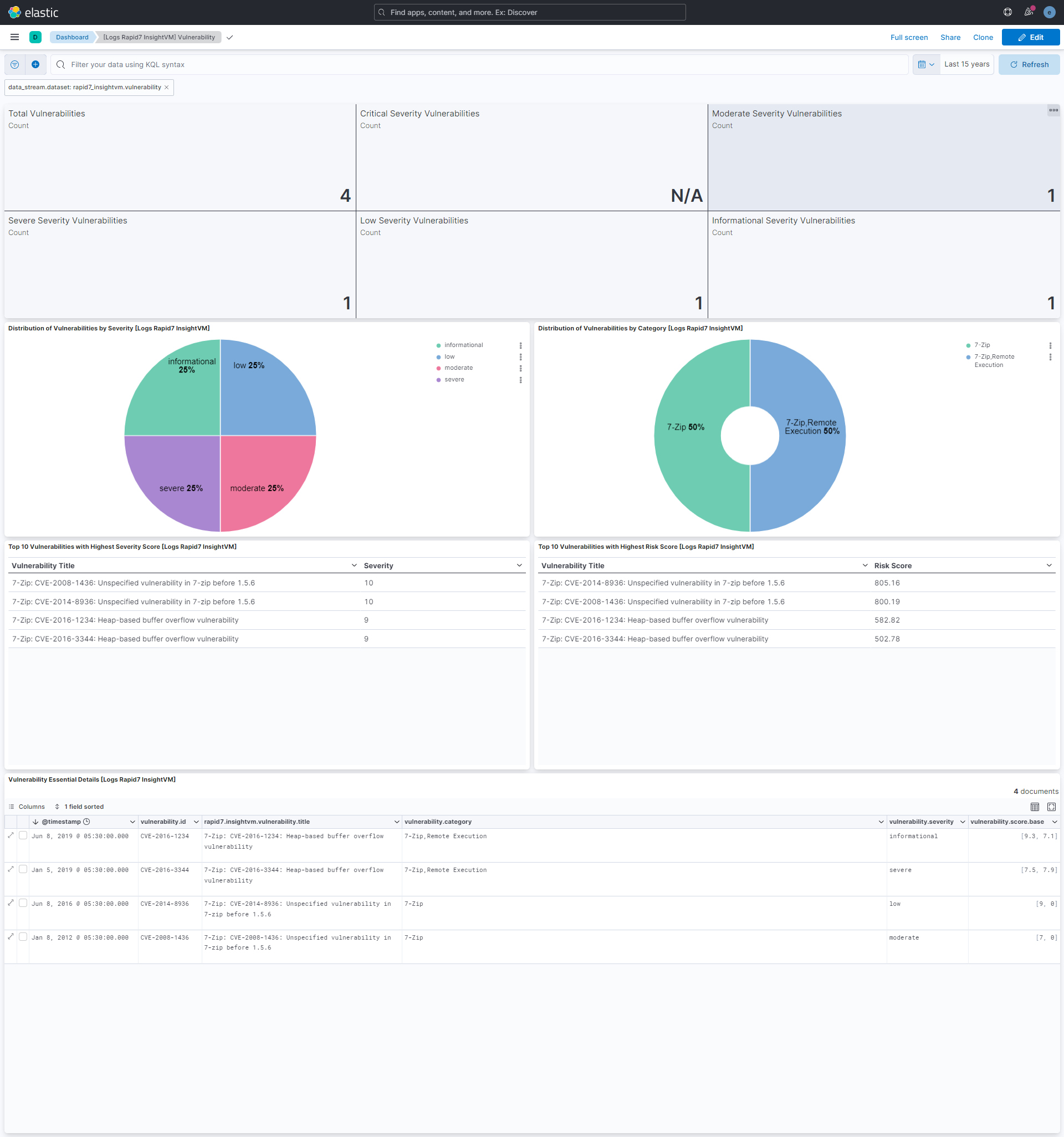
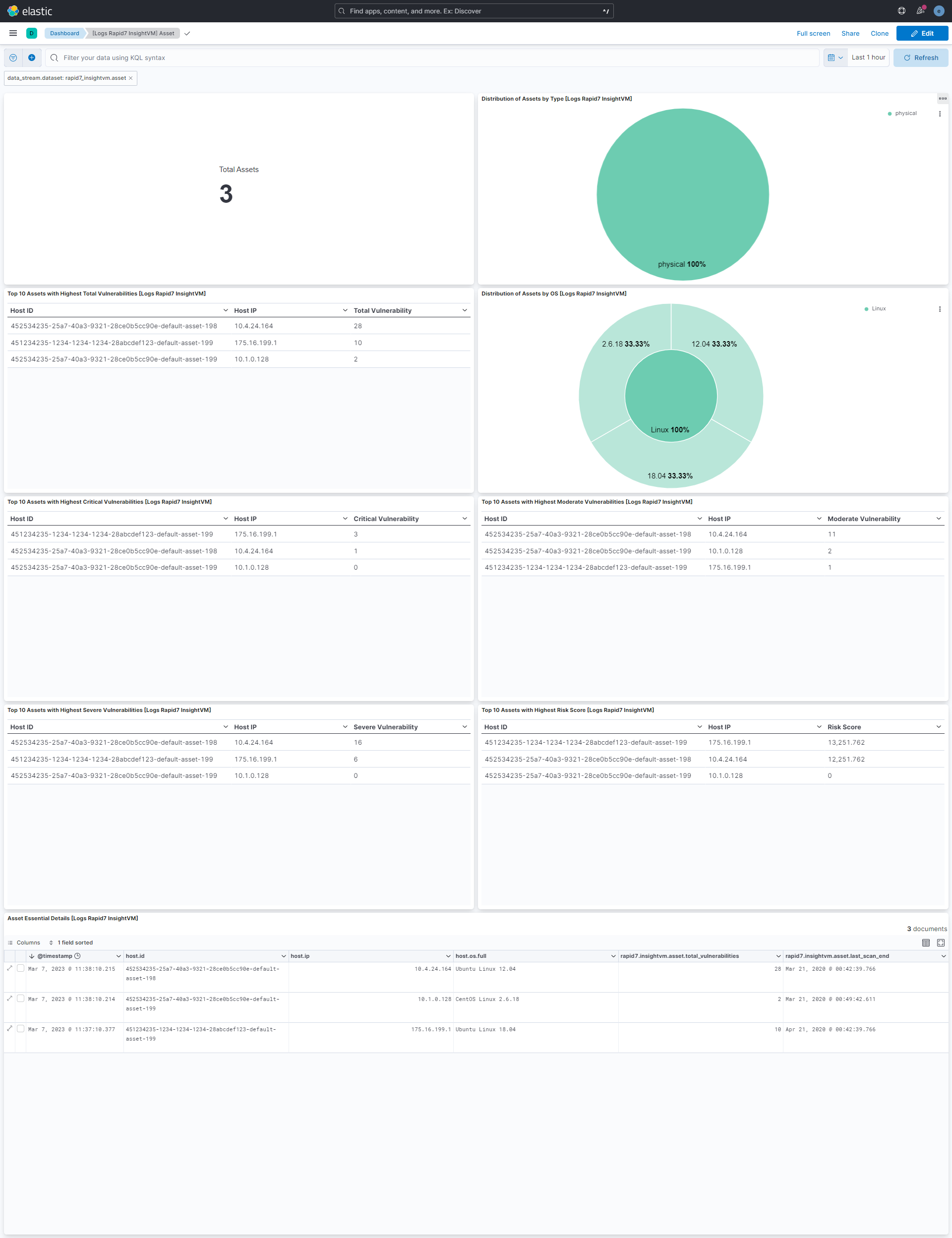
This integration includes one or more Kibana dashboards that visualizes the data collected by the integration. The screenshots below illustrate how the ingested data is displayed.
Changelog
| Version | Details | Minimum Kibana version |
|---|---|---|
| 2.14.0 | Enhancement (View pull request) Update Elastic Managed integration documentation to the current wording and docs links. |
9.1.4 8.19.4 |
| 2.13.0 | Enhancement (View pull request) Re-order integration inputs to show the CEL input before the HTTPJSON input, describe inputs by the data streams they collect rather than by input type, and make the deprecation of the asset data stream stand out in favour of asset_vulnerability. |
9.1.4 8.19.4 |
| 2.12.0 | Enhancement (View pull request) Set number_of_shards: 3 on the latest_cdr_vulnerabilities transform destination index and bump its destination index version to avoid Elasticsearch shard-size warnings at scale. |
9.1.4 8.19.4 |
| 2.11.0 | Enhancement (View pull request) Enable request trace log removal. |
9.1.4 8.19.4 |
| 2.10.0 | Enhancement (View pull request) Add tags to ingest pipeline processors. |
9.1.4 8.19.4 |
| 2.9.2 | Bug fix (View pull request) Add missing field definition for rapid7.insightvm.asset.same.reintroduced. Bug fix (View pull request) Fix array normalization for host.mac. |
9.1.4 8.19.4 |
| 2.9.1 | Enhancement (View pull request) Set agentless deployment mode release field to ga. |
9.1.4 8.19.4 |
| 2.9.0 | Enhancement (View pull request) Use new release field for agentless deployment mode to establish as beta. |
9.1.4 8.19.4 |
| 2.8.0 | Enhancement (View pull request) Add timestamp range filter and storage tier exclusion to latest transform source queries to reduce scan scope and improve performance. |
9.1.4 8.19.4 |
| 2.7.0 | Enhancement (View pull request) Add nested fields to asset and asset_vulnerability data streams. |
9.1.4 8.19.4 |
| 2.6.1 | Bug fix (View pull request) Use triple-brace Mustache templating when referencing variables in ingest pipelines. |
9.1.4 8.19.4 |
| 2.6.0 | Enhancement (View pull request) Removed ECS field definitions from CDR transform destinations, now covered by ecs@mappings component template. Renamed overridden ECS fields files to ecs-overridden.yml. |
9.1.4 8.19.4 |
| 2.5.1 | Bug fix (View pull request) Remove duplicated field definitions in transform. |
9.1.4 8.19.4 |
| 2.5.0 | Enhancement (View pull request) Add cloudsecurity_cdr sub category label |
9.1.4 8.19.4 |
| 2.4.1 | Bug fix (View pull request) Update transform to filter out documents containing an error.message from vulnerability latest index |
9.1.4 8.19.4 |
| 2.4.0 | Enhancement (View pull request) Prevent updating fleet health status to degraded. |
9.1.4 8.19.4 |
| 2.3.0 | Enhancement (View pull request) Add vulnerability_workflow sub category label. |
9.1.0 8.19.0 |
| 2.2.0 | Enhancement (View pull request) Avoid updating fleet health status to degraded when HTTPJSON template value evaluation is empty. |
9.1.0 8.19.0 |
| 2.1.0 | Enhancement (View pull request) Use terminate processor instead of fail processor to handle agent errors. |
9.1.0 8.19.0 |
| 2.0.0 | Breaking change (View pull request) Add asset_vulnerability datastream support for the Cloud Detection and Response (CDR) vulnerability workflow.This will require a transform node, the necessary permissions to use the transform, and specified source and destination indices. It also stores the latest copy of vulnerabilities in the destination indices, which will require additional storage. Bug fix (View pull request) Add temporary processor to remove the fields added by the Agentless policy. |
9.1.0 8.19.0 |
| 1.16.0 | Enhancement (View pull request) Update Kibana constraint to support 9.0.0. |
9.0.0 8.13.0 |
| 1.15.1 | Bug fix (View pull request) Updated SSL description in package manifest.yml to be uniform and to include links to documentation. |
8.13.0 |
| 1.15.0 | Enhancement (View pull request) Add "preserve_original_event" tag to documents with event.kind manually set to "pipeline_error". |
8.13.0 |
| 1.14.0 | Enhancement (View pull request) Do not remove event.original in main ingest pipeline. |
8.13.0 |
| 1.13.0 | Enhancement (View pull request) Add "preserve_original_event" tag to documents with event.kind set to "pipeline_error". |
8.13.0 |
| 1.12.0 | Enhancement (View pull request) Removed import_mappings. Update the kibana constraint to ^8.13.0. Modified the field definitions to remove ECS fields made redundant by the ecs@mappings component template. |
8.13.0 |
| 1.11.0 | Enhancement (View pull request) Improve handling of empty responses. |
8.12.0 |
| 1.10.0 | Enhancement (View pull request) Canonicalize host.name to lower case and map subdomain to host.hostname. |
8.12.0 |
| 1.9.0 | Enhancement (View pull request) Set sensitive values as secret. |
8.12.0 |
| 1.8.2 | Enhancement (View pull request) Changed owners |
8.7.1 |
| 1.8.1 | Bug fix (View pull request) Split vulnerability categories into array. |
8.7.1 |
| 1.8.0 | Enhancement (View pull request) Limit request tracer log count to five. |
8.7.1 |
| 1.7.0 | Enhancement (View pull request) ECS version updated to 8.11.0. |
8.7.1 |
| 1.6.0 | Enhancement (View pull request) Improve 'event.original' check to avoid errors if set. |
8.7.1 |
| 1.5.0 | Enhancement (View pull request) ECS version updated to 8.10.0. |
8.7.1 |
| 1.4.0 | Enhancement (View pull request) The format_version in the package manifest changed from 2.11.0 to 3.0.0. Removed dotted YAML keys from package manifest. Added 'owner.type: elastic' to package manifest. |
8.7.1 |
| 1.3.0 | Enhancement (View pull request) Add tags.yml file so that integration's dashboards and saved searches are tagged with "Security Solution" and displayed in the Security Solution UI. |
8.7.1 |
| 1.2.0 | Enhancement (View pull request) Update package to ECS 8.9.0. |
8.7.1 |
| 1.1.0 | Enhancement (View pull request) Document duration units. |
8.7.1 |
| 1.0.1 | Bug fix (View pull request) Remove confusing error message tag prefix. |
8.7.1 |
| 1.0.0 | Enhancement (View pull request) Release Rapid7 InsightVM as GA. |
8.7.1 |
| 0.4.0 | Enhancement (View pull request) Update package to ECS 8.8.0. |
8.7.1 |
| 0.3.0 | Enhancement (View pull request) Update package-spec version to 2.7.0. |
8.7.1 |
| 0.2.0 | Enhancement (View pull request) Add a new flag to enable request tracing |
8.7.1 |
| 0.1.1 | Enhancement (View pull request) Update Rapid7 InsightVM logo. |
8.4.0 |
| 0.1.0 | Enhancement (View pull request) Initial release. |
8.4.0 |