Skills in Elastic Agent Builder
Elastic Cloud Serverless projects are autoscaled environments, fully managed by Elastic and available on Elastic Cloud. Availability This functionality is generally available and ready for production usage. Serverless interfaces and procedures might differ from classic Elastic Stack deployments. The Elastic Stack includes Elastic's core products such as Elasticsearch, Kibana, Logstash, and Beats. Availability This functionality is generally available and ready for production usage. Unless stated otherwise on the page, this functionality is available when your Elastic Stack is deployed on Elastic Cloud Hosted, Elastic Cloud Enterprise, Elastic Cloud on Kubernetes, and self-managed environments. This documentation corresponds to the latest patch available for each minor version. If you're not using the latest patch, check the release notes for changes.
Serverless
Generally available
Stack
9.4+
Generally available since 9.4
A skill is a reusable capability pack that gives an agent specialized expertise for a particular type of task. Each skill bundles three things:
- Instructions: domain-specific guidance written in Markdown that shapes how the agent approaches the task.
- Tools: built-in or custom tools the agent can call while the skill is active.
- Context: additional knowledge the skill can draw on, such as reference documents or runbooks.
This makes skills different from tools, which are discrete operations like running a query or retrieving a document. Skills sit one level higher, combining tools with the instructions and context needed to complete a workflow end to end.
Skills also differ from the agent's system prompt. The system prompt is always in context, while skills load selectively. An agent can have access to many skills without loading them all into the context window at once. You author a skill once and assign it to any agent that needs it, keeping agent configurations clean and making expertise easy to share across your team.
Skills can be invoked in three ways:
- Automatic discovery (default)
-
The agent receives a list of available skills with their names and descriptions. Based on the user's natural language input, it automatically selects and invokes the most relevant skill. No special syntax is needed.
The Elastic Stack includes Elastic's core products such as Elasticsearch, Kibana, Logstash, and Beats. Availability Planned We plan to add this functionality in a future Elastic Stack update. Subject to changes. Unless stated otherwise on the page, this functionality is available when your Elastic Stack is deployed on Elastic Cloud Hosted, Elastic Cloud Enterprise, Elastic Cloud on Kubernetes, and self-managed environments. This documentation corresponds to the latest patch available for each minor version. If you're not using the latest patch, check the release notes for changes. Elastic Cloud Serverless projects are autoscaled environments, fully managed by Elastic and available on Elastic Cloud. Availability Preview This functionality is in technical preview and is ready for evaluation. Use with caution in production; it is not recommended for mission-critical workloads. Elastic will work to fix any issues, but features in technical preview are not subject to the support SLA of official GA features. Specific Support terms apply. Serverless interfaces and procedures might differ from classic Elastic Stack deployments. When the
agentBuilder:experimentalFeaturesadvanced setting is turned on and a fast model that's different from the conversation's model is available, the agent doesn't receive the full list. Instead, for each new message, the fast model reviews the message and recent conversation and passes the agent up to five relevant skills, or none if no skill clearly applies. If the agent has three or fewer skills, it receives all of them. At any point in the conversation, the agent can also search the skills available to it for one that fits a specific task. - Slash commands
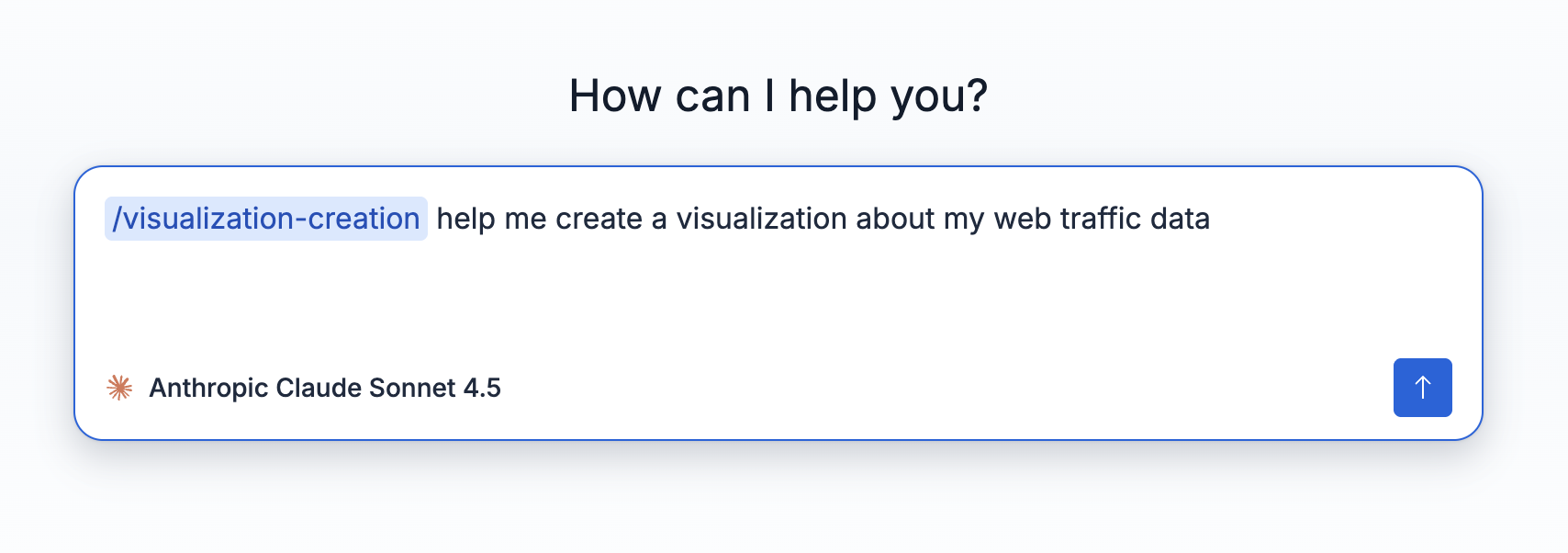
- Users can explicitly invoke a skill by typing
/followed by the skill name and a prompt. This is useful when you know exactly which skill you need.
- Attachment-driven
- When a user attaches contextual data to a message (for example, an alert from the alert flyout), the agent can automatically invoke the relevant skill based on the attachment type.
Use skills when you have domain-specific knowledge or procedures that multiple agents should follow consistently. Some examples:
- An Elastic Security user asks about a suspicious host. The
entity-analyticsskill activates and guides the agent through finding the entity, analyzing its risk score, asset criticality, and behavioral history. - An Elastic Observability user asks why a service is slow or why an alert fired. The
observability.investigationskill activates and diagnoses the issue across APM services and infrastructure. - An Elasticsearch user asks how to combine keyword and vector search for a product catalog. The
search.vector-hybrid-searchskill activates and guides the agent through building a hybrid search solution.
Elastic Agent Builder ships with built-in skills for common task domains. The skills available depend on your solution or serverless project type: some skills are available across all deployments, while others are specific to Elasticsearch, Observability, or Elastic Security. Built-in skills are read-only and cannot be modified or deleted.
For the complete list, refer to Built-in skills reference.
You can extend the built-in catalog with your own custom skills. Custom skills are saved to your skill library, which you can manage from Manage components > Skills. Creating a skill adds it to the library, but it is not available to any agent until you add it from Customize > Skills on that agent. This separation means you can maintain a shared library of skills and choose which ones each agent has access to.
To learn how to create and manage custom skills, refer to Custom skills.
To retrieve all available skills programmatically, use the List skills API endpoint: GET /api/agent_builder/skills. For the full set of skills CRUD operations, refer to Custom skills.
- Review all built-in skills in the Built-in skills reference.
- Learn how to create your own in Custom skills.
- Write effective custom skill instructions with the Skill creation guidelines.
- Explore Tools in Elastic Agent Builder to understand how tools and skills relate.
- Bundle skills for distribution using Plugins in Elastic Agent Builder.