Uni-directional disaster recovery
Elastic Cloud Hosted lets you manage and configure one or more deployments of the versioned Elastic Stack, hosted on Elastic Cloud. Availability This functionality is generally available and ready for production usage. Elastic Cloud on Kubernetes extends Kubernetes orchestration capabilities to allow you to deploy and manage components of the Elastic Stack. Availability This functionality is generally available and ready for production usage. This documentation corresponds to the latest patch available for each minor version. If you're not using the latest patch, check the release notes for changes. Elastic Cloud Enterprise is a self-managed orchestration platform for deploying and managing the Elastic Stack at scale. Availability This functionality is generally available and ready for production usage. This documentation corresponds to the latest patch available for each minor version. If you're not using the latest patch, check the release notes for changes. Self-managed deployments are Elastic Stack deployments managed without the assistance of an orchestrator. Availability This functionality is generally available and ready for production usage. This documentation corresponds to the latest patch available for each minor version. If you're not using the latest patch, check the release notes for changes.
ECH
Generally available
ECK
Generally available
ECE
Generally available
Self-managed
Generally available
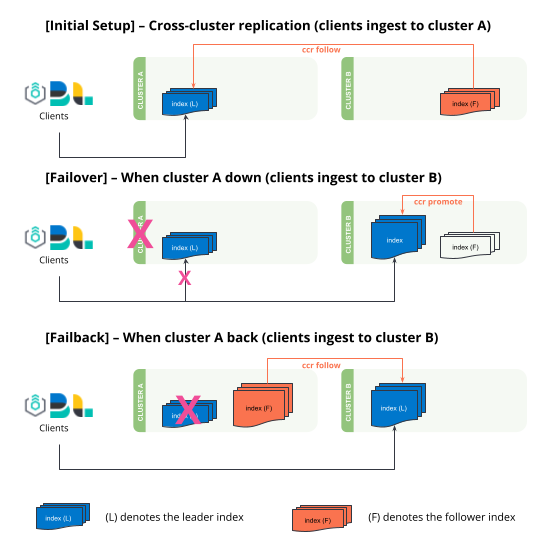
Learn how to failover and failback between two clusters based on uni-directional cross-cluster replication. You can also visit Bi-directional disaster recovery to set up replicating data streams that automatically failover and failback without human intervention.
- Setting up uni-directional cross-cluster replication replicated from
clusterAtoclusterB. - Failover - If
clusterAgoes offline,clusterBneeds to "promote" follower indices to regular indices to allow write operations. All ingestion will need to be redirected toclusterB, this is controlled by the clients (Logstash, Beats, Elastic Agents, etc). - Failback - When
clusterAis back online, it assumes the role of a follower and replicates the leader indices fromclusterB.
Cross-cluster replication provides functionality to replicate user-generated indices only. Cross-cluster replication isn’t designed for replicating system-generated indices or snapshot settings, and can’t replicate ILM or SLM policies across clusters. Learn more in cross-cluster replication limitations.