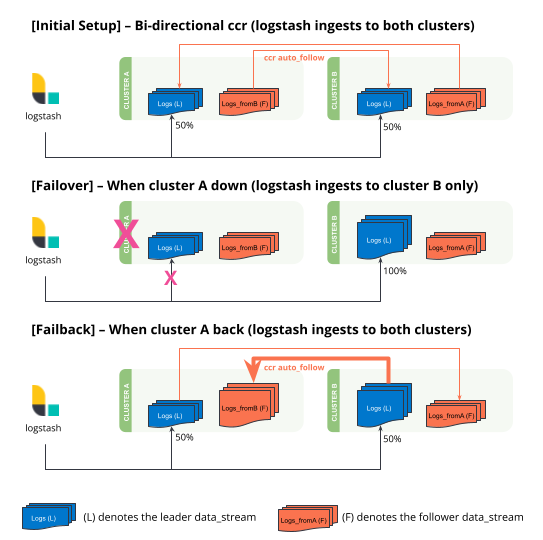
Bi-directional disaster recovery
Elastic Cloud Hosted lets you manage and configure one or more deployments of the versioned Elastic Stack, hosted on Elastic Cloud. Availability This functionality is generally available and ready for production usage. Elastic Cloud on Kubernetes extends Kubernetes orchestration capabilities to allow you to deploy and manage components of the Elastic Stack. Availability This functionality is generally available and ready for production usage. This documentation corresponds to the latest patch available for each minor version. If you're not using the latest patch, check the release notes for changes. Elastic Cloud Enterprise is a self-managed orchestration platform for deploying and managing the Elastic Stack at scale. Availability This functionality is generally available and ready for production usage. This documentation corresponds to the latest patch available for each minor version. If you're not using the latest patch, check the release notes for changes. Self-managed deployments are Elastic Stack deployments managed without the assistance of an orchestrator. Availability This functionality is generally available and ready for production usage. This documentation corresponds to the latest patch available for each minor version. If you're not using the latest patch, check the release notes for changes.
ECH
Generally available
ECK
Generally available
ECE
Generally available
Self-managed
Generally available
Learn how to set up disaster recovery between two clusters based on bi-directional cross-cluster replication. The following tutorial is designed for data streams which support update by query and delete by query. You can only perform these actions on the leader index.
This tutorial works with Logstash as the source of ingestion. It takes advantage of a Logstash feature where the Logstash output to Elasticsearch can be load balanced across an array of hosts specified. Beats and Elastic Agents currently do not support multiple outputs. It should also be possible to set up a proxy (load balancer) to redirect traffic without Logstash in this tutorial.
- Setting up a remote cluster on
clusterAandclusterB. - Setting up bi-directional cross-cluster replication with exclusion patterns.
- Setting up Logstash with multiple hosts to allow automatic load balancing and switching during disasters.