TheHive connector and action
Elastic Cloud Serverless projects are autoscaled environments, fully managed by Elastic and available on Elastic Cloud. Availability This functionality is generally available and ready for production usage. Elastic Cloud Serverless projects are autoscaled environments, fully managed by Elastic and available on Elastic Cloud. Availability This functionality is generally available and ready for production usage. The Elastic Stack includes Elastic's core products such as Elasticsearch, Kibana, Logstash, and Beats. Availability This functionality is generally available and ready for production usage. Unless stated otherwise on the page, this functionality is available when your Elastic Stack is deployed on Elastic Cloud Hosted, Elastic Cloud Enterprise, Elastic Cloud on Kubernetes, and self-managed environments. This documentation corresponds to the latest patch available for each minor version. If you're not using the latest patch, check the release notes for changes.
Serverless Observability
Generally available
Serverless Security
Generally available
Stack
Generally available
TheHive connector uses the TheHive (v1) REST API to create cases and alerts. [8.16.0]
If you use this connector with cases, the status values differ in Kibana and TheHive. The status values are not synchronized when you update a case.
You can create connectors in Stack Management > Connectors or as needed when you're creating a rule. For example:
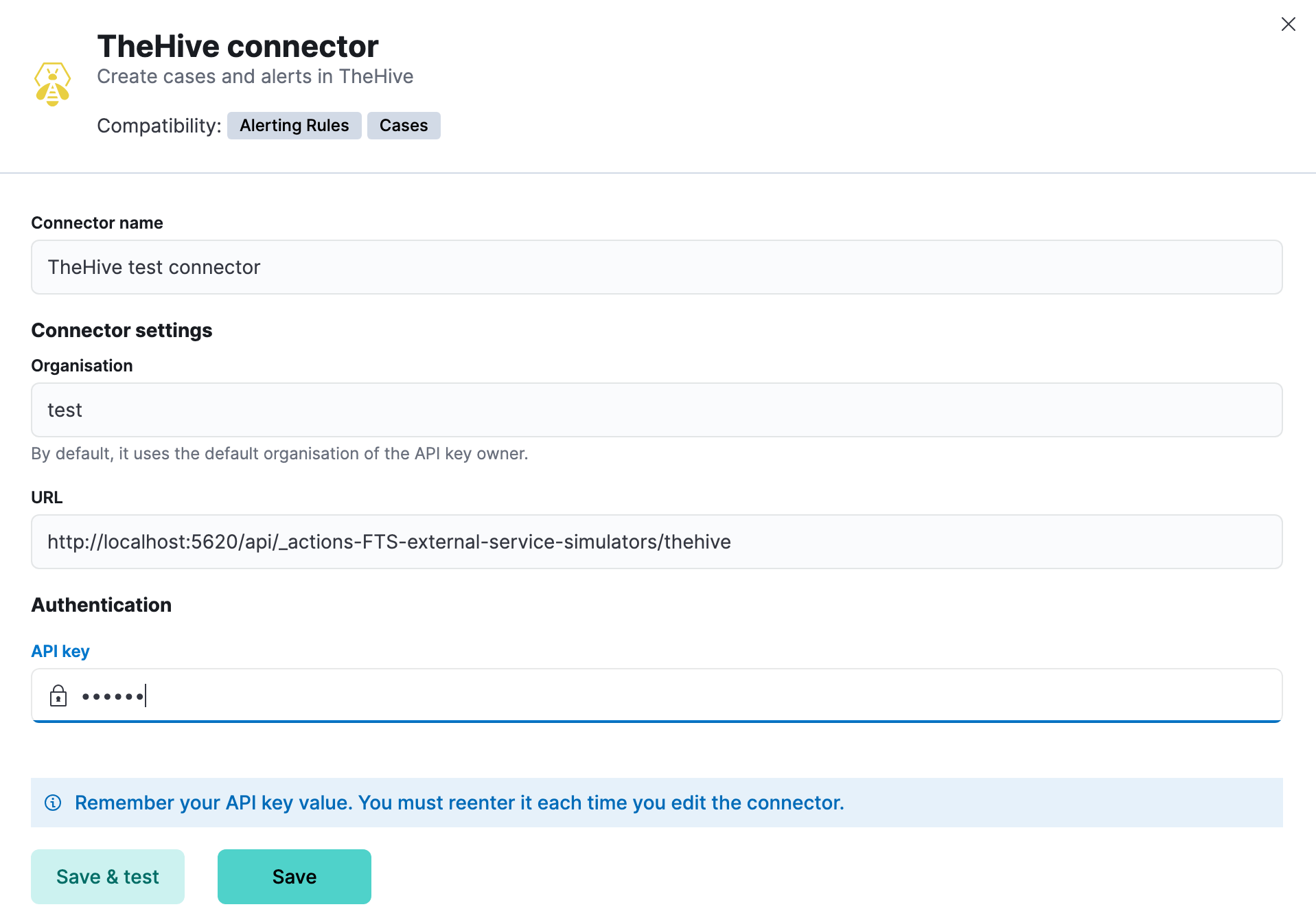
TheHive connectors have the following configuration properties:
- Name
- The name of the connector.
- Organisation
- The organisation in TheHive that will contain the cases or alerts.
- URL
- The instance URL in TheHive.
- API key
- The API key for authentication in TheHive.
You can test connectors for creating a case or an alert with the run connector API or as you're creating or editing the connector in Kibana. For example:
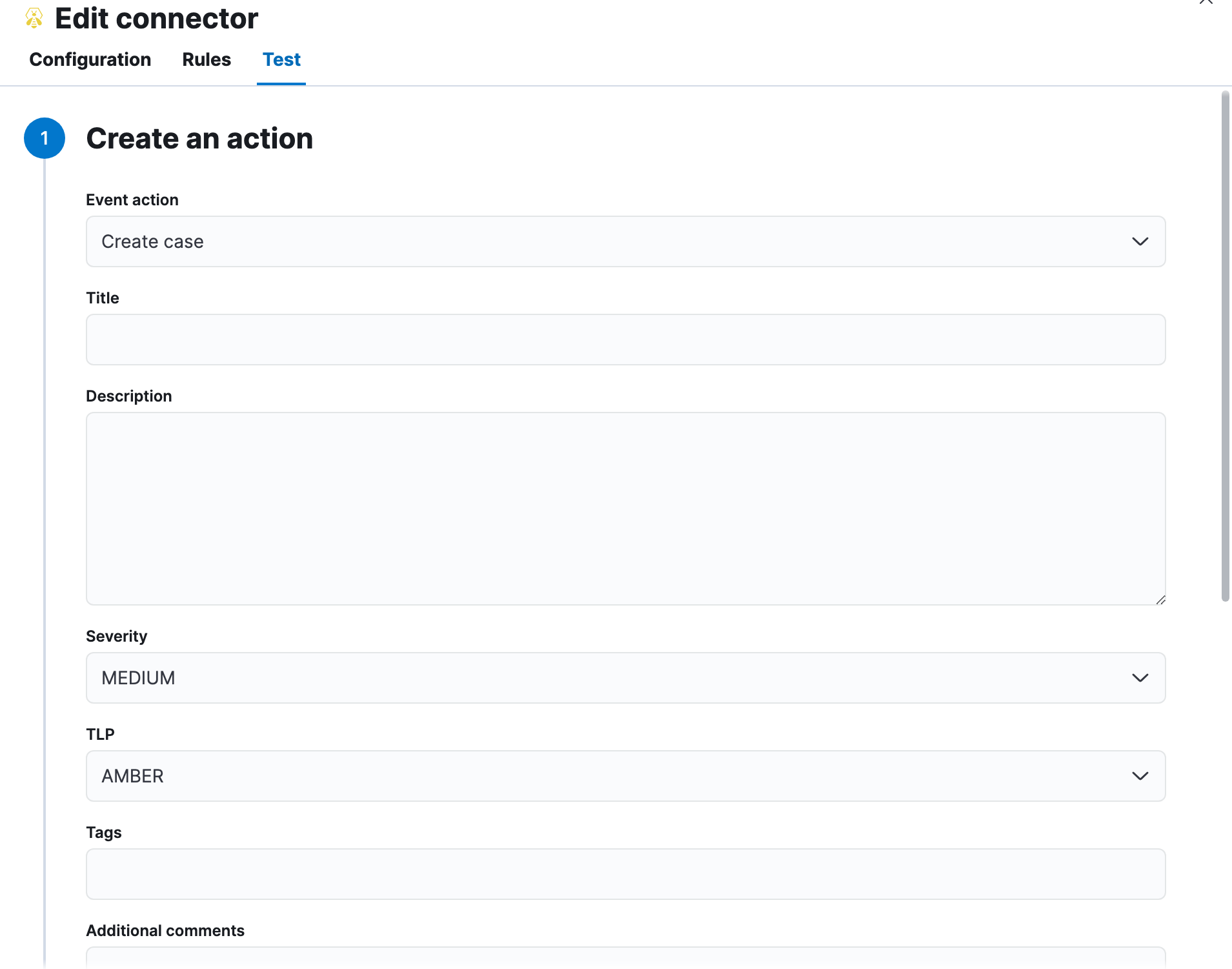
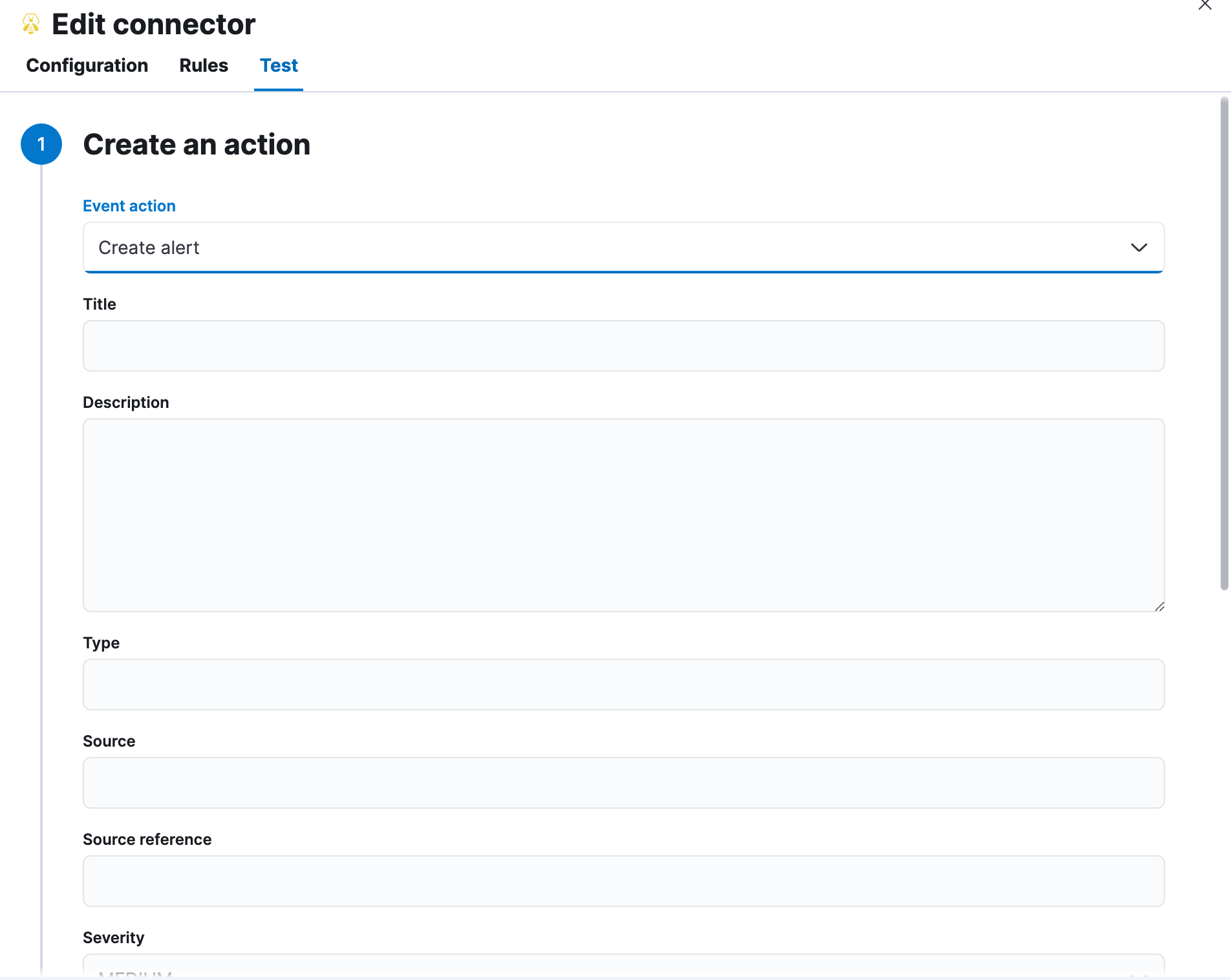
TheHive actions have the following configuration properties.
- Event action
- The action that will be performed in TheHive: create a case or an alert.
- Title
- The title of the incident.
- Description
- The details about the incident.
- Severity
-
The severity of the incident:
LOW,MEDIUM,HIGHorCRITICAL.NoteThe Elastic Stack includes Elastic's core products such as Elasticsearch, Kibana, Logstash, and Beats. Availability Generally available since 9.1 This functionality is generally available and ready for production usage. Unless stated otherwise on the page, this functionality is available when your Elastic Stack is deployed on Elastic Cloud Hosted, Elastic Cloud Enterprise, Elastic Cloud on Kubernetes, and self-managed environments. This documentation corresponds to the latest patch available for each minor version. If you're not using the latest patch, check the release notes for changes. While creating an alert, use the Keep severity from rule toggle to create an alert with the rule's severity. If the rule does not have a defined severity, the alert will have the default MEDIUM severity.
- TLP
- The traffic light protocol designation for the incident:
CLEAR,GREEN,AMBER,AMBER+STRICTorRED. - Tags
- The keywords or tags for the incident.
- Additional comments
- Additional information about the incident.
- Type
- The type of alert.
- Source
- The source of the alert.
- Source reference
- A source reference for the alert.
- Body The Elastic Stack includes Elastic's core products such as Elasticsearch, Kibana, Logstash, and Beats. Availability Generally available since 9.1 This functionality is generally available and ready for production usage. Unless stated otherwise on the page, this functionality is available when your Elastic Stack is deployed on Elastic Cloud Hosted, Elastic Cloud Enterprise, Elastic Cloud on Kubernetes, and self-managed environments. This documentation corresponds to the latest patch available for each minor version. If you're not using the latest patch, check the release notes for changes.
-
A Json payload specifying additional parameter, such as observables and procedures. For example:
JSON { "observables": [ { "dataType": "url", "data": "<EXAMPLE_URL>" } ], "procedures": [ { "patternId": "TA0001", "occurDate": 1640000000000, "tactic": "tactic-name" } ] }
Use the Action configuration settings to customize connector networking configurations, such as proxies, certificates, or TLS settings. You can set configurations that apply to all your connectors or use xpack.actions.customHostSettings to set per-host configurations.
To generate an API key in TheHive:
- Log in to your TheHive instance.
- Open profile tab and select the settings.
- Go to API Key.
- Click Create if no API key has been created previously; otherwise, you can view the API key by clicking on Reveal.
- Copy the API key value to configure the connector in Kibana.